
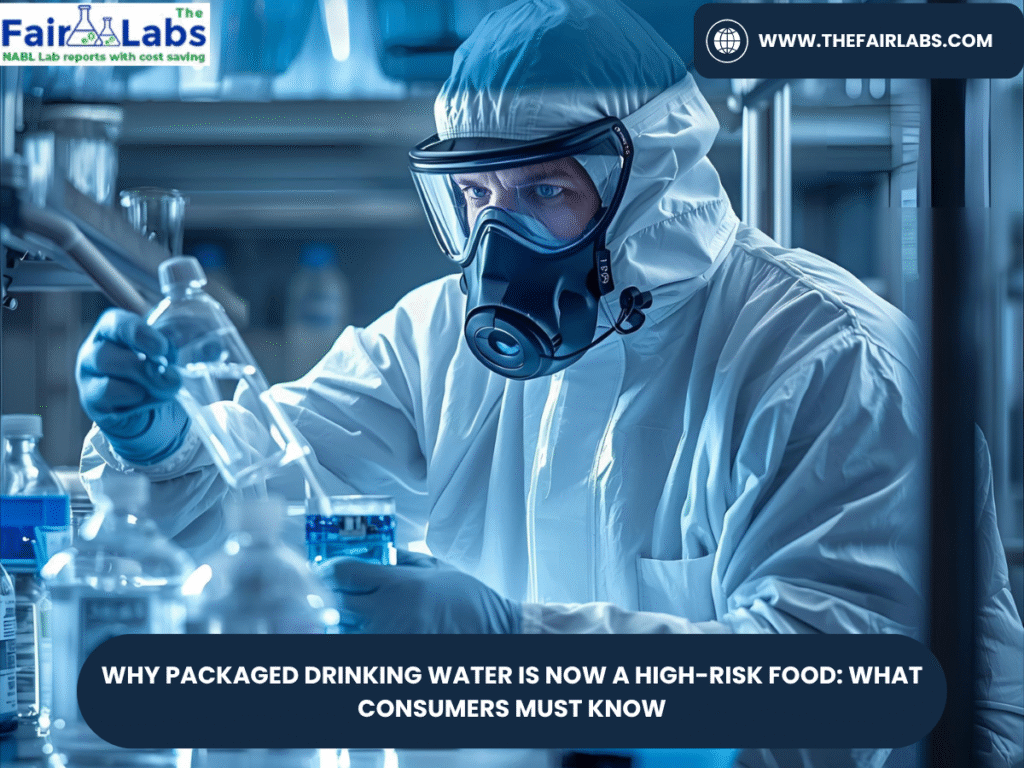
Packaged drinking water has always been considered a safe, convenient option—a basic necessity in the modern, mobile world. But a major regulatory change put into force by the Food Safety and Standards Authority of India has raised the bar on just how ‘safe’ that “safe” water really is. In November 2024, FSSAI officially classified packaged drinking water, including mineral water, as a high-risk food category.
While this shift might sound alarming, it is actually a move designed to protect public health. In this article, we will unpack what this means for manufacturers and consumers—and how your own trusted lab can help safeguard your drinking water.
What does FSSAI’s new classification mean?
High-Risk Food Category
Accordingly, under the policy for Risk-Based Inspection Scheduling, FSSAI labels those foods “high-risk” that are more likely to be adulterated or contain safety hazards. From November 29, 2024, packaged drinking water and mineral water will be added to this category.
Mandatory Inspections before Licensure
The new rule states that any manufacturer or processor of packaged water must undergo a pre-license inspection. This was not always mandatory for all players.
Annual Inspections & Audits
Once licensed, these manufacturers are not off the hook. They face annual, risk-based inspections, and centrally licensed companies must also go through yearly third-party audits by FSSAI-recognized food safety agencies.
Removal of BIS Certification, but Stricter Oversight
Earlier, packaged water manufacturers required certification issued by the Bureau of Indian Standards. That mandatory BIS certification requirement has been removed for some products.
However, to make up for the loss of that dual certification, FSSAI is tightening scrutiny through inspection and audit.
Improved Consumer Safety
This reclassification isn’t a scare tactic; rather, it’s about ensuring measures for safety are paramount. According to FSSAI, a high-risk tag provides more frequent and thorough checks to protect consumers.
What does this mean for manufacturers?
For bottling companies, or those producing mineral water, for instance, this change is immense:
Additional Regulatory Burden
Annual inspections are required for license renewals of manufacturers, which means more documentation, more checking, and quite probably more cost.
Third-Party Audits
For centrally licensed manufacturers in particular, third-party food safety audits are now required annually.
Quality Systems Matter More
Companies will have to invest more in quality control infrastructure, GMP, and internal auditing in order to pass inspections.
Increased Scrutiny
Due to the higher risk classification, food safety authorities might scrutinize manufacturing processes more closely—from the sourcing of water to bottling and storage.
No BIS, But Not a Free Pass
The easing of mandatory BIS certification for some doesn’t imply the quality bar has been lowered. In fact, oversight by the FSSAI has become more robust.
Business Standard
Consumer Confidence Is Key
In the long run, stricter audits and inspections could make consumers more confident in the packaged water brands that comply well, thereby giving the responsible manufacturers a competitive edge.
What Should Consumers Do? (Practical Tips)
Check for a Valid FSSAI License Number.
Check the FSSAI license number or registration number on the label of the bottle.
You can cross-check the number from FSSAI’s FoSCoS portal to know whether or not the manufacturer is licensed.
A genuine license means that the brand is operating under regulatory oversight.
Bottle quality inspection
Ensure that the seal is intact and not tampered with.
Look at the material of the bottle: repeatedly used or broken bottles (especially for big canisters) are risky.
Reports in certain cases have pointed out flaws such as wear, lack of transparency, or missing ISI marks in some 20-liter bubble-top cans.
Read the Label Carefully
Besides the FSSAI number, check for the manufacturing date, expiry date, batch number, and nutritional or mineral content, if listed.
Proper labeling is an indicator that the company is serious about compliance.
Source Wisely
Buy from trusted and reputable brands.
Preferably, avoid unbranded or very cheap water bottles/cans, as they may cut corners to save money.
Make sure the seller is reliable; unauthorized vendors may sell substandard or counterfeit products.
Observe Appearance and Taste
Good quality packaged water should be clear, colorless, and free from any odors.
If it tastes odd, is cloudy, or has visible particles in it, it is better to avoid it.
Raise Awareness/Complaints
In case of counterfeit bottles, inappropriate labels, or suspicion that your bottled water is not safe, you can report it to your local food safety authority or FSSAI.
You, as a consumer, have the right to demand transparency and quality.
How Testing Labs—Like Ours—Can Help
This is where professional water-testing labs—such as ours—come into play:
Testing can be conducted for a wide array of parameters, including microbiological (bacteria, pathogens), chemical (heavy metals, pH, TDS), and physical (turbidity, particulate matter).
Third-Party Validation
Consumers or brands might utilize independent labs to validate water quality. This adds a layer of assurance beyond what labels say.
Batch Testing
Testing individual batches or random bottles helps to monitor consistency across production.
Custom reports from labs detail exactly what was tested, how the sample fared, and whether it is within regulatory limits.
Regulatory Support
We assist manufacturers in maintaining compliance with the tighter inspections by FSSAI through the provision of pre-audit testing.
Consumer Confidence
If brands publicize lab testing results—or at least part of them—consumers may feel more confident.
Our Services: At The Fair Labs, we specifically offer drinking water testing in India, tailored for both consumers and businesses. You can learn more on our site. Drinking Water Testing Lab – The Fair Labs
Why This Matters
Does that suddenly make drinking water dangerous because of this? The answer is no, not necessarily. The reclassification by the FSSAI did not imply that all packaged water was unsafe; rather, it was a precautionary and protective step.
India Today
By categorizing bottled water as “high-risk,” the FSSAI is ensuring that its manufacturers are under stricter regulatory scrutiny. This, over time, should raise the general standard of packaged water in the market. And for you, the consumer—understanding this change empowers you to make safer choices, demanding transparency and double-checking what you drink.
Conclusion
Surprising though it might seem, the fact that FSSAI has marked packaged drinking water as high-risk is a welcome step to ensure public health. To be sure, stricter inspections, mandatory audits, and enhanced compliance not only protect us but also force the industry to be better.
There are things one can do to make a difference: being aware and checking the labels, verifying licenses, and even sending samples to be tested. And then there are labs like The Fair Labs to provide support to both individuals and businesses with their reliable independent testing services.
And when it comes to water, which we all need daily, safety should be non-negotiable.