
Pharmaceutical & Drug Testing Services in India
Pharmaceutical manufacturing carries a responsibility unlike any other industry: every tablet, capsule, injectable, or oral solution must consistently meet exacting standards of quality, safety, and efficacy — because patient health depends on it. Pharmaceutical and Drug Testing is the scientific backbone that makes this possible, verifying that every batch released to the market is safe, effective, and compliant with regulatory requirements.
From raw material qualification through finished product release and post-market stability monitoring, laboratory testing underpins drug quality assurance, patient safety, regulatory compliance with GMP, CDSCO, and pharmacopoeial standards, manufacturing consistency across batches, product efficacy through validated potency and dissolution profiles, robust quality control systems, batch release testing, and export readiness for regulated international markets.
The Fair Labs provides professional Pharmaceutical and Drug Testing using advanced analytical instrumentation and internationally accepted testing methodologies. Our NABL-accredited laboratory supports pharmaceutical manufacturers, API producers, CMOs, CROs, and biotechnology companies with dependable, regulatory-grade testing across the entire product lifecycle.
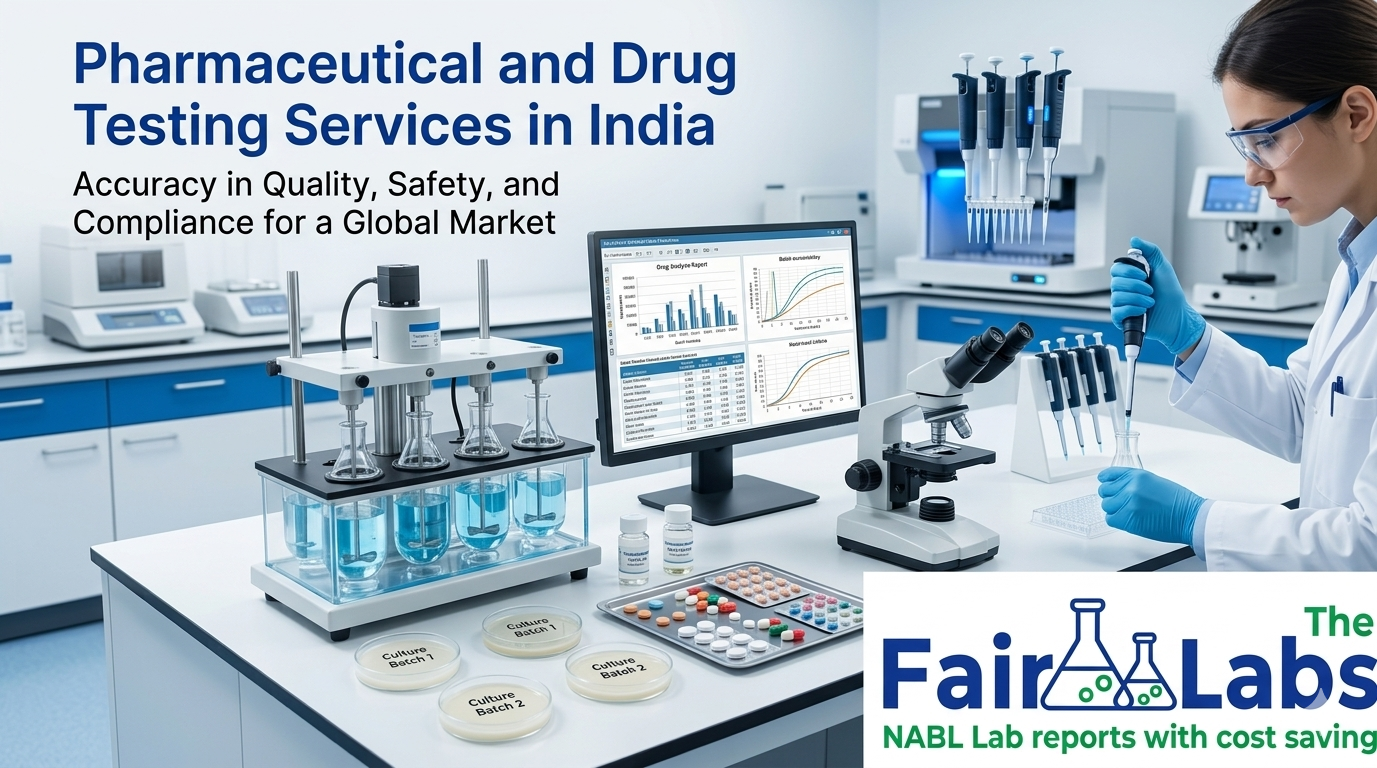
What is Pharmaceutical and Drug Testing?
Pharmaceutical and Drug Testing is the systematic laboratory evaluation of raw materials, in-process samples, and finished pharmaceutical products to confirm their identity, purity, potency, safety, and overall compliance with pharmacopoeial and regulatory standards.
Testing plays a role at every stage of the pharmaceutical lifecycle — raw material qualification before manufacturing begins, in-process controls during formulation and production, finished product testing prior to batch release, stability monitoring throughout the product's shelf life, and post-market surveillance to confirm ongoing quality. At its core, pharmaceutical testing ensures a drug product's quality, safety, purity, potency, and efficacy — the five pillars that regulatory authorities and patients alike depend on.
Laboratory testing is the analytical engine that feeds data into QC decisions, QA oversight, and validation studies — making it foundational to every layer of pharmaceutical quality management. No pharmaceutical batch should reach a patient without documented proof that it meets defined specifications: testing before release confirms the product is safe and effective, prevents distribution of substandard or contaminated batches, provides the data required for regulatory submissions, and supports export documentation and Certificates of Analysis (CoA) required by international regulators.
Why Pharmaceutical Testing is Important
Pharmaceutical testing supports multiple critical business and compliance functions:
Quality & Compliance Benefits
- Patient Safety — testing protects patients from contamination, incorrect dosage, degradation products, and other risks that could compromise health outcomes
- Product Quality — verified identity, assay, and physical characteristics ensure every unit meets its intended quality specification
- GMP Compliance — Good Manufacturing Practices require documented, validated testing as part of a compliant quality system
- Regulatory Compliance — testing generates the data required by CDSCO and international regulators to approve and monitor pharmaceutical products
- Batch Release — no batch should be distributed without passing defined release testing criteria
- Manufacturing Consistency — routine testing detects process drift and ensures consistency across batches and manufacturing sites
- Product Stability — stability testing confirms that a product retains its quality, potency, and safety throughout its shelf life
- Export Compliance — international markets require testing aligned with USP, BP, Ph. Eur., and destination-country regulatory requirements
- Audit Readiness — robust, well-documented testing records support successful regulatory inspections and audits
- Brand Reputation — consistent quality, backed by reliable testing, protects long-term brand credibility and market trust
Risks of Inadequate Pharmaceutical Testing
- Product recalls
- Failed batch release
- Regulatory action or license suspension
- Microbial or particulate contamination
- Incorrect dosage or potency
- Patient safety risks and adverse events
- Export rejection at port of entry
- Loss of market authorization
Pharmaceutical Products We Test
Solid Dosage Forms
Tablets, Capsules, Powders, Granules
Liquid Formulations
Syrups, Oral Suspensions, Oral Solutions, Drops
Semi-Solid Products
Creams, Ointments, Gels, Lotions, Pastes
Sterile Products
Injectables, IV Fluids, Ophthalmic Preparations, Sterile Powders
Other Categories
APIs, Nutraceutical Products, Herbal Pharmaceutical Products, Medical Device Related Products
Pharmaceutical Testing Services
Raw Material Testing
Before manufacturing begins, incoming raw materials — including APIs and excipients — must be qualified for identity, purity, assay, and overall quality. This prevents substandard or incorrect materials from entering the production process.
Finished Product Testing
Finished product testing forms the basis of batch release testing, confirming that a completed product meets all defined specifications before it is approved for commercial distribution.
Stability Testing
- Accelerated Stability Studies — elevated temperature/humidity conditions to predict shelf life quickly
- Real-Time Stability Studies — long-term monitoring under actual storage conditions to confirm labeled shelf life
Microbiological Testing
- Sterility testing for injectables and sterile preparations
- Microbial limits testing for non-sterile products
- Bacterial endotoxin testing (where applicable)
- Pathogen detection and screening
Dissolution & Disintegration Testing
For oral solid dosage forms, dissolution and disintegration testing predict how a tablet or capsule will release its active ingredient in the body — a critical indicator of bioavailability and therapeutic performance.
Assay & Potency Testing
Assay testing quantifies the active pharmaceutical ingredient present in a formulation, confirming that the product delivers the labeled therapeutic dose.
Impurity & Related Substance Testing
This testing detects degradation products, process-related impurities, and related substances that may form during manufacturing or storage, ensuring they remain within pharmacopoeially defined safety limits.
Method Development & Validation
Analytical methods must be validated according to international guidelines (such as ICH Q2) to confirm their accuracy, precision, specificity, and reproducibility before routine use in testing.
Understanding QC, QA, Method Validation, Stability Testing, and Batch Release Testing
Manufacturers often confuse these interconnected but distinct pharmaceutical quality concepts.
Batch Release Testing is the final testing checkpoint before commercial distribution, answering "Can this specific batch be released to the market?" Understanding these distinctions helps manufacturers build a complete, compliant quality program — method validation ensures your tests are trustworthy, QC generates the data, QA governs the system, stability testing predicts long-term performance, and batch release testing is the final gate before a product reaches patients.
Laboratory Parameters
| Parameter | Purpose | Analytical Method | Importance |
|---|---|---|---|
| Identification | Confirms the correct active ingredient is present | HPLC, FTIR, UV-Visible Spectrophotometry | Prevents mix-ups and mislabeling |
| Assay | Quantifies active ingredient concentration | HPLC, UPLC | Confirms therapeutic dose accuracy |
| Dissolution | Measures drug release rate from solid dosage forms | Dissolution Test Apparatus | Predicts bioavailability |
| Disintegration | Measures breakdown time of tablets/capsules | Disintegration Test Apparatus | Indicates formulation performance |
| Uniformity of Dosage Units | Confirms consistent dose across units | HPLC, Weight Variation | Ensures dosing accuracy |
| Content Uniformity | Verifies even distribution of active ingredient | HPLC | Prevents under/over-dosing |
| Related Substances | Detects process-related impurities | HPLC, LC-MS/MS | Ensures product purity |
| Impurities | Identifies degradation products | HPLC, GC-MS | Confirms product safety over time |
| Moisture Content | Measures water content | Karl Fischer Titration | Affects stability and degradation |
| pH | Measures acidity/alkalinity | pH meter | Impacts stability and compatibility |
| Sterility | Confirms absence of viable microorganisms | Membrane filtration, direct inoculation | Critical for injectables and sterile products |
| Microbial Limits | Measures total bacterial/fungal load | Microbiological culture methods | Ensures product safety |
| Endotoxins (where applicable) | Detects bacterial endotoxins | LAL Test | Prevents febrile reactions in patients |
Laboratory Methods & Instrumentation
The Fair Labs employs a comprehensive range of validated analytical instrumentation.
Validated analytical methods, performed on qualified and calibrated instrumentation, ensure reliable, reproducible pharmaceutical quality evaluation — data that regulatory authorities and international buyers can trust.
Standards & Regulations We Follow
Compliance with IP, USP, BP, Ph. Eur., ICH Guidelines, and GMP matters because it enables global market access, gives credibility to validated and internationally accepted test methods, harmonizes quality expectations across major regulatory regions, reduces the risk of non-compliance findings during audits, and improves export competitiveness. Standardized laboratory testing built on these frameworks supports regulatory approval, strengthens audit readiness, and enables global market acceptance of pharmaceutical products manufactured in India.
Industries We Serve
Our Testing Process
Why Choose The Fair Labs?
Related Testing Services
- Stability Chamber Studies
- Real-Time Shelf Life Studies
- Microbiological Testing
- Heavy Metal Testing
- Packaging Material Testing
- Water Testing
- Nutritional Analysis (for Nutraceuticals)
- Ayurvedic and Herbal Products Testing
- Cosmetics and Personal Care Testing