
Dietary Fiber Analysis Services in India
Dietary fiber has moved from a niche nutritional concept to one of the most closely watched components on a food label. Rising rates of lifestyle-related disorders, growing consumer awareness of gut health, and the booming demand for high-fiber cereals, bakery products, snacks, and nutraceuticals have made accurate fiber quantification a business necessity rather than a formality. Whether a brand is marketing a "high fiber" breakfast cereal, formulating a fiber-enriched nutrition bar, or preparing export documentation for a functional food, the numbers printed on the label must be scientifically defensible.
Fiber content cannot be reliably estimated from ingredient lists or generic nutrition databases. Processing, cooking, extrusion, and formulation changes all alter the measurable fiber fraction in a finished product. Regulatory bodies such as FSSAI require nutrition labeling values that reflect the actual composition of the product as sold — not theoretical calculations. This makes laboratory-based dietary fiber analysis essential for nutrition label compliance, health claim validation, product formulation, quality assurance, and international export requirements.
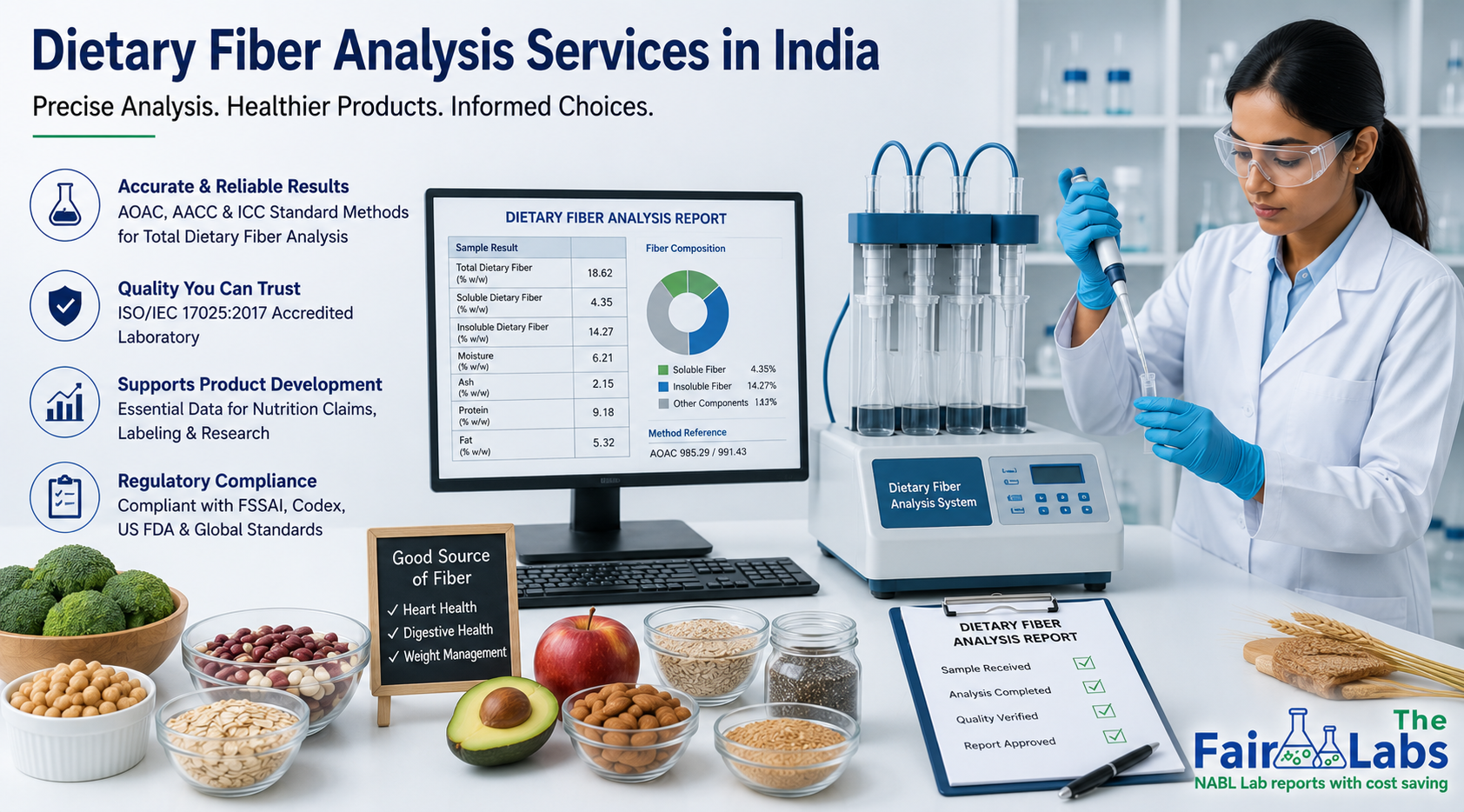
The Fair Labs provides professional Dietary Fiber Analysis services in India using validated AOAC enzymatic-gravimetric methods and advanced analytical techniques. Our NABL-accredited laboratory helps food manufacturers, nutraceutical companies, and health food brands generate accurate, defensible fiber data for labeling, formulation, and regulatory submissions.
What is Dietary Fiber Analysis?
Dietary fiber refers to the carbohydrate polymers and related substances that are not digested or absorbed in the human small intestine. This includes plant-derived non-starch polysaccharides, lignin, resistant starch, and certain functional fibers added during formulation. Because these components pass largely intact into the large intestine, they play a distinct physiological role compared to digestible carbohydrates — supporting digestive health, glycemic control, and satiety.
It is important to understand the distinction between soluble and insoluble fiber:
A complete nutritional profile requires quantification of both fractions, along with the combined Total Dietary Fiber (TDF) value.
Many manufacturers rely on calculated fiber values derived from raw ingredient specifications or published food composition tables. These estimates do not account for changes introduced by processing — such as extrusion, baking, fermentation, or fortification — and can significantly overstate or understate the actual fiber content of the finished product. Laboratory-measured values, generated through validated AOAC methods, reflect the true composition of the product as consumed and are the only defensible basis for nutrition labeling and health claims.
Accurate dietary fiber analysis underpins Nutrition Facts Panel accuracy, "high fiber" or "source of fiber" health claims, product reformulation and R&D decisions, regulatory submissions in India and export markets, and batch-to-batch consistency verification.
Why Dietary Fiber Analysis is Important
Dietary fiber analysis supports multiple critical business and compliance functions:
Quality & Compliance Benefits
- Nutrition Label Compliance — fiber content is a mandatory declaration on most packaged food labels; inaccurate values expose manufacturers to regulatory action and consumer complaints
- FSSAI Compliance — FSSAI's Food Safety and Standards (Labelling and Display) Regulations require nutrition information to reflect scientifically determined values
- Export Compliance — international markets apply their own labeling frameworks and fiber-related health claim thresholds; unvalidated data risks documentation rejection, customs delays, or recalls
- Functional Food Development — functional and fiber-fortified products depend on precise quantification to validate formulation targets and substantiate functional claims
- Health Claim Validation — claims such as "good source of fiber," "high fiber," or "supports digestive health" require laboratory substantiation
- Product Quality Assurance — routine testing confirms formulations meet internal specifications despite raw material variability
- Batch Consistency — testing identifies fiber content inconsistencies between production batches before they reach the market
- Consumer Trust — accurate, verifiable nutrition data builds long-term consumer confidence in a brand's transparency and product quality
- Scientific Product Positioning — laboratory-backed fiber data allows brands to confidently position products in the high-fiber, functional food, or nutraceutical categories
Risks of Inaccurate Fiber Data
- Incorrect nutrition labels leading to regulatory notices
- Misleading fiber claims and consumer complaints
- Regulatory non-compliance under FSSAI regulations
- Export shipment rejection at destination markets
- Product recalls and associated costs
- Damage to brand reputation and consumer trust
Types of Dietary Fiber We Analyze
The Fair Labs quantifies the complete range of fiber fractions relevant to food, nutraceutical, and functional food products.
Soluble Dietary Fiber
- Beta-glucan — found in oats and barley, associated with cholesterol management
- Pectin — common in fruits, used as a gelling and stabilizing agent
- Inulin — a prebiotic fiber widely used in functional food formulations
- Gums — including guar gum and xanthan gum used as fiber and texturizing agents
- Mucilages — plant-derived soluble fiber components
Insoluble Dietary Fiber
- Cellulose — structural plant cell wall component
- Hemicellulose — associated with cellulose in plant cell walls
- Lignin — a non-carbohydrate structural component classified within dietary fiber
- Resistant plant cell wall components — contributing to insoluble fiber bulk
Total Dietary Fiber
Total Dietary Fiber represents the combined measurement of soluble and insoluble fractions and is the value most commonly required on nutrition labels. Accurate TDF determination is essential for regulatory compliance and consumer-facing claims.
Resistant Starch & Functional Fiber
Resistant starch escapes digestion in the small intestine and behaves physiologically like dietary fiber, contributing to gut health benefits. Functional fibers, whether naturally occurring or added during formulation, are increasingly relevant in nutraceutical and functional food development and require the same rigor in laboratory quantification.
Products We Test
Cereals & Grains
Oats, Wheat, Rice, Millets, Corn Products
Bakery Products
Bread, Biscuits, Cookies, Cakes, Crackers
Snacks
Extruded Snacks, Granola, Nutrition Bars, Fiber-Enriched Snacks
Nutraceutical Products
Fiber Supplements, Powders, Capsules, Gummies
Functional Foods
Formulated products designed to deliver targeted fiber intake alongside other functional ingredients
Dairy & Beverage Products
Fiber-fortified dairy products, functional beverages, and fiber-enriched drink mixes
Herbal & Health Foods
Herbal formulations, health mixes, and traditional foods marketed on fiber content
Analytical Parameters
| Parameter | Purpose | Analytical Method | Importance |
|---|---|---|---|
| Total Dietary Fiber | Combined fiber quantification | AOAC 991.43 / AOAC 2009.01 | Core nutrition label requirement |
| Soluble Fiber | Quantifies water-soluble fiber fraction | AOAC Enzymatic-Gravimetric Method | Supports specific health claims |
| Insoluble Fiber | Quantifies water-insoluble fiber fraction | AOAC Enzymatic-Gravimetric Method | Confirms bulking fiber content |
| Resistant Starch | Measures starch resistant to digestion | AOAC 2011.25 | Relevant to glycemic and gut health claims |
| Beta-Glucan | Quantifies beta-glucan content | AOAC 995.16 / Enzymatic Method | Supports cholesterol-related claims |
| Inulin | Quantifies inulin/prebiotic fiber | HPLC | Validates prebiotic formulation claims |
| Moisture Correction | Adjusts results to standardized basis | Gravimetric Drying | Ensures comparability of results |
| Ash Correction | Removes inorganic residue interference | Gravimetric Ashing | Improves analytical accuracy |
These parameters, taken together, provide a complete and scientifically robust picture of a product's fiber composition, supporting both regulatory declarations and formulation decisions.
Laboratory Methods & Analytical Techniques
The Fair Labs applies internationally recognized AOAC methods for dietary fiber determination, ensuring results are accepted across regulatory and export markets.
Standardized AOAC methods are internationally accepted because they are validated through inter-laboratory studies, ensuring reproducibility and comparability of results across laboratories and regulatory jurisdictions. Using AOAC-validated methods strengthens the defensibility of nutrition label declarations and health claims.
Standards & Guidelines We Follow
Accredited fiber analysis strengthens regulatory acceptance of test reports, reduces the risk of customs or labeling disputes, and reinforces consumer confidence in the accuracy of nutrition information.
Industries We Serve
Our Testing Process
Why Choose The Fair Labs?
Related Testing Services
- Macronutrient Analysis
- Vitamin and Mineral Profiling
- Nutritional Analysis
- Food Label Testing
- Shelf Life Testing
- Food Adulteration Testing
- Heavy Metal Testing
- Microbiological Testing
- Stability Studies