
Fatty Acid Profiling Services in India
The fat content on a food label is no longer just a single number. Regulators, health-conscious consumers, and export markets increasingly expect brands to demonstrate exactly what kind of fat their products contain — saturated, monounsaturated, polyunsaturated, omega fatty acids, and trans fats. This level of detail cannot be estimated from formulation records or generic databases; it requires precise laboratory measurement of the individual fatty acid composition of the product.
Fatty acid composition affects far more than nutrition labeling. It determines the nutritional quality of edible oils, influences shelf life and oxidative stability, and serves as a scientific fingerprint for detecting oil adulteration and verifying product authenticity. For edible oil manufacturers, dairy producers, nutraceutical companies, and food exporters, an accurate fatty acid profile is essential for quality assurance, regulatory compliance, and maintaining consumer trust.
The Fair Labs provides professional Fatty Acid Profiling services in India using advanced chromatographic techniques and internationally accepted laboratory methods. Our NABL-accredited laboratory helps manufacturers verify product authenticity, support nutrition labeling, detect adulteration, and meet regulatory and export requirements with scientifically defensible data.
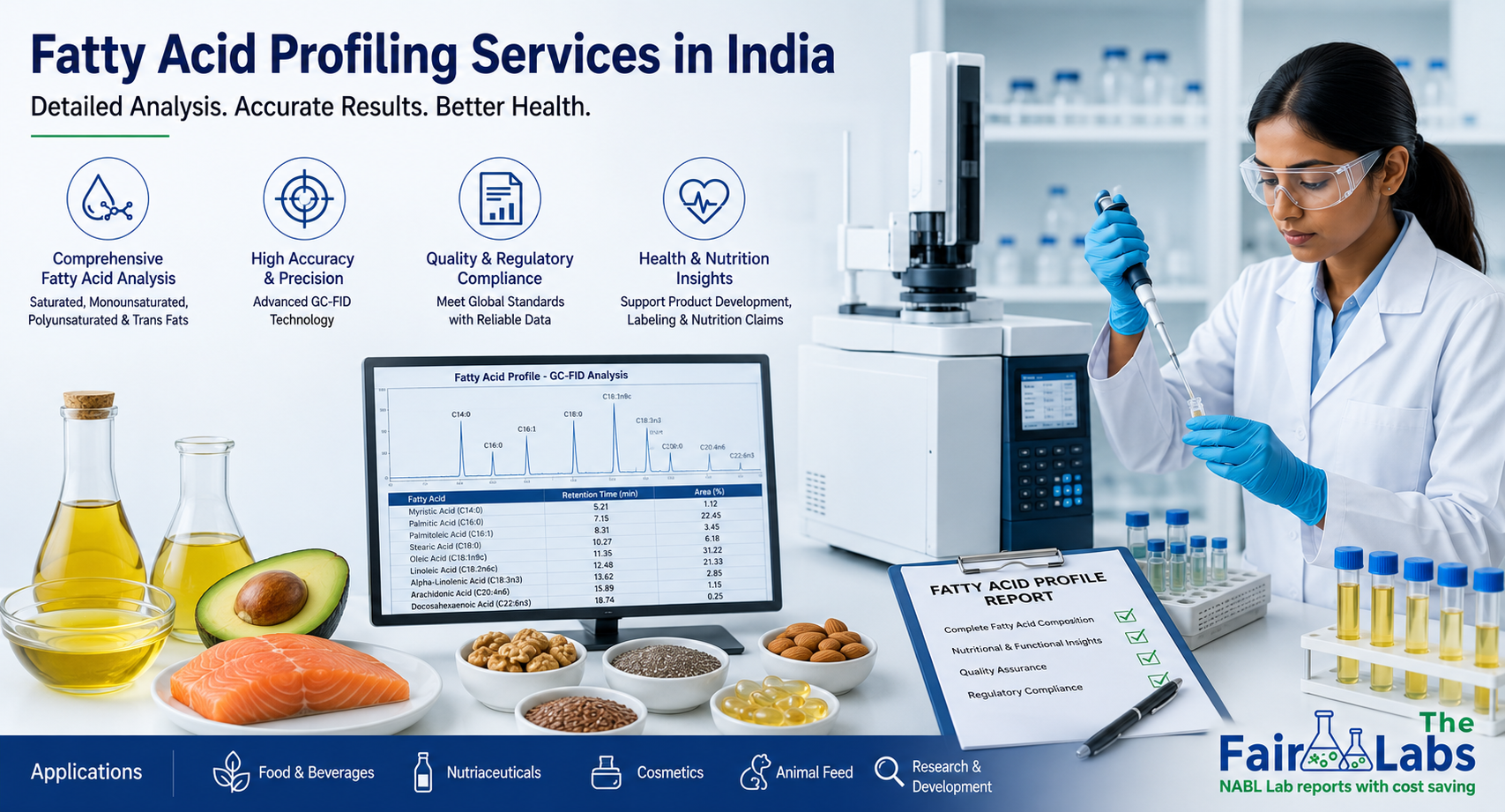
What is Fatty Acid Profiling?
Fatty acid profiling is the laboratory determination of the individual fatty acids present in a fat or oil sample, expressed as a percentage of total fatty acid content. Rather than reporting a single "total fat" figure, fatty acid profiling breaks that fat down into its constituent saturated, monounsaturated, polyunsaturated, and trans fatty acids — providing a detailed compositional fingerprint of the sample.
It is important to understand the distinction between total fat analysis and fatty acid profiling:
Fatty acid composition directly affects the nutritional character of a product, influencing claims related to heart health, essential fatty acid content, and overall dietary quality. Every edible oil also has a characteristic fatty acid signature, and deviations from this expected profile can indicate blending, substitution, or dilution with cheaper oils — making fatty acid profiling a powerful authenticity verification tool.
Consistent fatty acid composition across batches confirms that raw material sourcing and processing conditions remain within specification, while oil adulteration — whether through blending with lower-cost oils or mislabeling of oil type — can be identified by comparing a sample's fatty acid profile against known reference ranges for that oil type.
Why Fatty Acid Profiling is Important
Fatty acid profiling supports multiple critical business and compliance functions:
Quality & Compliance Benefits
- Nutrition Label Compliance — accurate fatty acid data ensures that saturated fat, unsaturated fat, and trans fat declarations reflect the true composition of the product
- FSSAI Compliance — FSSAI's Food Safety and Standards (Labelling and Display) Regulations require nutrition declarations, including fat sub-categories, to be based on validated laboratory analysis
- Export Compliance — international markets apply their own labeling frameworks and fat-related thresholds, particularly for trans fat and saturated fat, and export shipments require validated fatty acid data
- Product Authentication — fatty acid profiling verifies that an edible oil matches its declared identity and has not been blended or substituted
- Quality Assurance — routine profiling confirms that finished products consistently meet internal and regulatory fat composition specifications
- Detection of Oil Adulteration — comparing a sample's fatty acid ratios against established reference profiles reveals blending or dilution that would otherwise go undetected
- Batch-to-Batch Consistency — fatty acid analysis identifies variability introduced by raw material sourcing, storage conditions, or processing changes
- Product Development — R&D teams rely on fatty acid data to formulate products with targeted nutritional profiles, such as low-saturated-fat or omega-3-enriched formulations
- Regulatory Audits — accredited fatty acid test reports provide the documented evidence needed during regulatory inspections and audits
- Consumer Confidence — transparent, laboratory-verified fat composition data reinforces consumer trust in product quality and label accuracy
Risks of Skipping Fatty Acid Analysis
- Incorrect nutrition labels and fat sub-category declarations
- Undetected product adulteration
- Regulatory non-compliance under FSSAI regulations
- Export shipment rejection at destination markets
- Misleading nutritional claims
- Consumer complaints and loss of trust
- Long-term brand reputation damage
Fatty Acids We Analyze
The Fair Labs quantifies the complete range of fatty acid classes relevant to edible oils, dairy, nutraceutical, and functional food products.
Saturated Fatty Acids (SFA)
- Palmitic Acid — one of the most common saturated fatty acids in food fats
- Stearic Acid — prevalent in animal fats and some vegetable oils
- Myristic Acid — found in coconut and palm kernel oil
- Lauric Acid — a major component of coconut oil, relevant to functional food formulation
Saturated fatty acid levels are central to nutrition labeling and are closely scrutinized in heart-health-related claims and regulatory declarations.
Monounsaturated Fatty Acids (MUFA)
- Oleic Acid — the dominant fatty acid in olive oil and many premium edible oils
- Palmitoleic Acid — found in smaller quantities in various plant and animal fats
MUFAs are widely associated with favorable nutritional positioning in edible oils and health-focused food products.
Polyunsaturated Fatty Acids (PUFA)
- Linoleic Acid (Omega-6) — an essential fatty acid found in vegetable oils
- Alpha-Linolenic Acid (Omega-3) — an essential fatty acid important for cardiovascular and cognitive health claims
- Arachidonic Acid — relevant in infant nutrition and specialized formulations
PUFAs are essential nutrients that must be obtained through diet, making their accurate quantification important for nutritional labeling and functional food positioning.
Omega Fatty Acids
- Omega-3 — associated with cardiovascular and cognitive health benefits
- Omega-6 — an essential fatty acid requiring balanced dietary intake
- Omega-9 — a non-essential but nutritionally relevant monounsaturated fatty acid
Omega fatty acid ratios are increasingly featured in functional food and nutraceutical marketing, requiring precise laboratory substantiation.
Trans Fatty Acids
Trans fat testing is critical due to well-established health concerns associated with trans fat consumption. Regulatory frameworks, including FSSAI regulations, impose strict limits on trans fat content in food products, and accurate quantification is necessary to demonstrate compliance and protect consumer health.
Products We Test
Edible Oils
Mustard, Sunflower, Soybean, Groundnut, Rice Bran, Palm, Olive, Coconut, Blended Oils
Dairy Products
Milk, Butter, Cheese, Ghee, Cream
Food Products
Bakery Products, Snacks, Processed Foods, Ready-to-Eat Foods
Nutraceutical Products
Fish Oil, Omega Supplements, Soft Gel Capsules, Functional Foods
Infant Nutrition Products
Precise fatty acid profiling supporting formulation accuracy and regulatory compliance
Animal Feed
Fatty acid analysis supporting feed formulation quality and nutritional specification verification
Analytical Parameters
| Parameter | Purpose | Analytical Technique | Importance |
|---|---|---|---|
| Total Fat | Overall fat content quantification | Solvent Extraction / Gravimetric | Basic nutrition labeling requirement |
| Fatty Acid Composition | Individual fatty acid identification and quantification | GC-FID | Core profiling parameter for labeling and authenticity |
| Saturated Fat | Quantifies total saturated fatty acid content | GC-FID (FAME Analysis) | Mandatory nutrition label declaration |
| Monounsaturated Fat | Quantifies total MUFA content | GC-FID (FAME Analysis) | Supports nutritional quality assessment |
| Polyunsaturated Fat | Quantifies total PUFA content | GC-FID (FAME Analysis) | Relevant to essential fatty acid claims |
| Omega-3 | Quantifies omega-3 fatty acid content | GC-FID / GC-MS | Supports functional food and health claims |
| Omega-6 | Quantifies omega-6 fatty acid content | GC-FID / GC-MS | Supports essential fatty acid balance assessment |
| Omega-9 | Quantifies omega-9 fatty acid content | GC-FID | Relevant to oil quality characterization |
| Trans Fat | Quantifies trans fatty acid content | GC-FID (FAME Analysis) | Critical regulatory compliance parameter |
| Fatty Acid Ratio | Evaluates relative proportions of fatty acid classes | Calculated from GC Data | Supports authenticity and adulteration detection |
These parameters collectively provide manufacturers with a complete, laboratory-verified picture of fat quality — supporting nutrition labeling, authenticity verification, and regulatory compliance.
Laboratory Methods & Analytical Techniques
The Fair Labs applies internationally recognized chromatographic methods for fatty acid determination, ensuring results are reliable and accepted across regulatory and export markets.
GC-based fatty acid profiling is considered the international gold standard because it delivers high-resolution separation and quantification of individual fatty acids with a level of precision and reproducibility that alternative methods cannot match, making it the preferred technique for regulatory and export-grade testing worldwide.
Standards & Guidelines We Follow
Standardized fatty acid analysis, backed by accreditation, improves regulatory acceptance of test reports and strengthens product credibility with both regulators and consumers.
Industries We Serve
Our Testing Process
Why Choose The Fair Labs?
Related Testing Services
- Macronutrient Analysis
- Vitamin and Mineral Profiling
- Dietary Fiber Analysis
- Nutritional Analysis
- Food Label Testing
- Heavy Metal Testing
- Food Adulteration Testing
- Shelf Life Testing
- Microbiological Testing
Frequently Asked Questions
Get Accurate, Accredited Fatty Acid Profiling
Confident nutrition labeling, verified product authenticity, and smooth regulatory approval all start with reliable fatty acid data. The Fair Labs helps edible oil manufacturers, food producers, and nutraceutical companies across India generate scientifically validated fatty acid profiles they can stand behind.
- Accurate Fatty Acid Composition Analysis
- Reliable Nutrition Labeling
- Detection of Oil Adulteration
- Regulatory Compliance Support
- NABL Accredited Testing