
Ayurvedic & Herbal Products Testing in India
India's Ayurvedic and herbal products industry is built on centuries of traditional knowledge — but in today's regulated, export-driven marketplace, tradition alone is no longer enough to prove that a product is safe, authentic, and effective. Manufacturers, formulators, and brand owners must now back every claim with scientific evidence. This is where Ayurvedic and Herbal Products Testing becomes essential.
From raw botanical materials to finished Churna, Asava, Tailam, herbal cosmetics, and nutraceuticals, every stage of production carries risk — heavy metal contamination, pesticide residues, microbial load, adulteration, and inconsistent standardization. Comprehensive laboratory testing protects consumers, safeguards brand reputation, ensures regulatory compliance, and opens doors to domestic and export markets.
The Fair Labs provides professional Ayurvedic and Herbal Products Testing using advanced analytical techniques, internationally recognized laboratory methods, and a team of experienced herbal scientists, pharmacognosists, and regulatory experts. Whether you manufacture classical Ayurvedic medicines, herbal supplements, botanical extracts, or herbal cosmetics, our NABL-accredited laboratory helps you prove quality, safety, and authenticity at every stage.
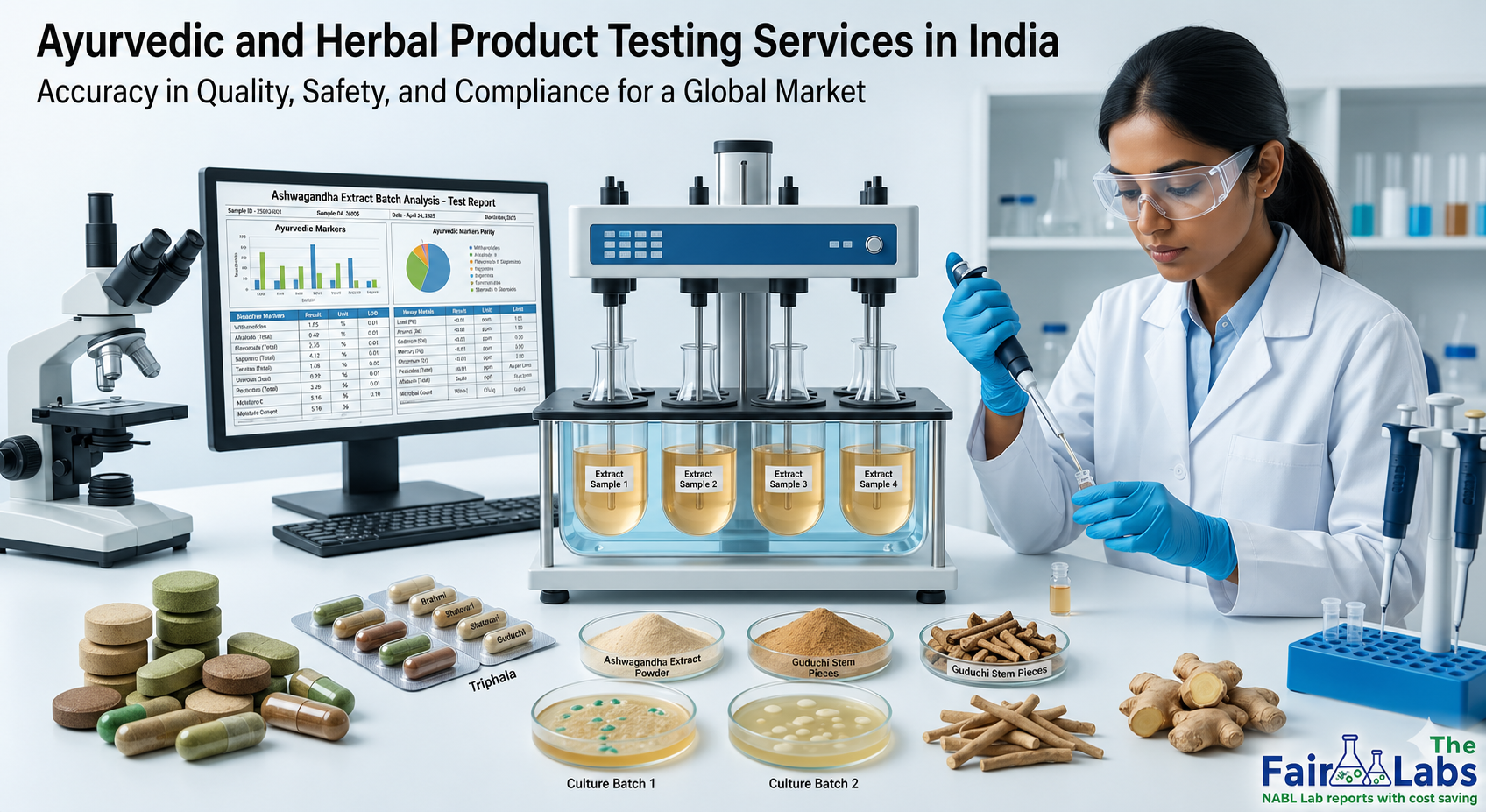
What is Ayurvedic and Herbal Products Testing?
Ayurvedic and Herbal Products Testing is the scientific evaluation of herbal raw materials, semi-finished formulations, and finished Ayurvedic or herbal products to confirm their identity, purity, safety, quality, and compliance with regulatory and pharmacopoeial standards.
Testing typically verifies botanical identity, purity and safety, standardization through marker compounds, authenticity of botanical ingredients, physicochemical properties such as moisture and ash values, and regulatory compliance with AYUSH, FSSAI, and pharmacopoeial monographs.
Because herbal raw materials are biological in origin, natural variability makes laboratory analysis before commercialization critical — it is the only reliable way to confirm that every batch meets defined quality and safety benchmarks before it reaches the consumer.
Why Ayurvedic and Herbal Products Testing is Important
Robust testing protects manufacturers, consumers, and the broader Ayurvedic industry across multiple dimensions:
Quality & Compliance Benefits
- Consumer Safety — testing identifies hidden risks such as heavy metals, pesticide residues, or microbial contamination before products reach consumers
- Product Quality — consistent potency and therapeutic value depend on verified concentrations of active phytochemicals
- AYUSH Compliance — manufacturers must demonstrate that products meet the standards defined in the Ayurvedic Pharmacopoeia of India and applicable AYUSH guidelines
- FSSAI Compliance (Where Applicable) — herbal products marketed as nutraceuticals or health supplements often fall under FSSAI's Health Supplements and Nutraceuticals Regulations
- Export Compliance — international markets impose strict contaminant limits and require documented evidence including certificates of analysis and stability data
- Raw Material Authentication — confirms that the correct species and plant part have been used, guarding against botanical misidentification and adulteration
- Batch-to-Batch Consistency — standardization testing counters natural variation in raw herbs to ensure consistent potency
- Product Standardization — marker compound analysis defines a measurable chemical fingerprint for each formulation
- Quality Assurance — systematic testing embedded into QA/QC processes reduces the risk of out-of-specification products reaching the market
- Brand Reputation — documented, third-party verified quality builds long-term trust with regulators, retailers, and consumers
Risks of Skipping Laboratory Testing
- Heavy metal contamination (lead, mercury, arsenic, cadmium)
- Pesticide residues from raw botanical materials
- Microbial contamination (bacteria, yeast, mould)
- Adulteration with cheaper or unauthorized plant material
- Incorrect herbal ingredients due to misidentification
- Regulatory action, license suspension, or product bans
- Costly product recalls
- Customer complaints and loss of brand trust
Products We Test
Ayurvedic Medicines
Tablets, Capsules, Syrups, Churna, Bhasma, Asava & Arishta, Kashayam, Tailam, Ghrita
Herbal Supplements
Herbal Capsules, Herbal Powders, Plant Extracts, Nutraceutical Products
Herbal Cosmetics
Herbal Creams, Face Wash, Shampoo, Oils, Soaps, Lotions
Raw Herbal Materials
Medicinal Plants, Dried Herbs, Roots, Bark, Seeds, Flowers, Leaves
Botanical Extracts & Beverages
Botanical Extracts, Essential Oils, Herbal Tea Products
Testing Parameters
Identity & Authentication Testing
- Botanical Identification — confirming genus and species against pharmacopoeial reference standards
- Microscopic Analysis — examining cellular and tissue structures unique to specific plant parts
- Macroscopic Examination — evaluating physical characteristics such as shape, color, texture, and odor
- Marker Compound Analysis — chemical fingerprinting using validated reference markers
Authentication testing is critical because it prevents substitution and adulteration — two of the most common quality failures in the herbal supply chain, where a cheaper or incorrect species is used in place of the specified medicinal plant.
Chemical Analysis
- Active phytochemicals
- Assay of marker compounds
- Heavy metals
- Residual solvents
- Moisture content
- Ash values
- Extractive values
Microbiological Testing
- Total Plate Count (TPC)
- Yeast & Mould count
- E. coli
- Salmonella
- Staphylococcus aureus
- Pseudomonas aeruginosa
Contaminant Testing
- Heavy metals (lead, arsenic, mercury, cadmium)
- Pesticide residues
- Aflatoxins
- Mycotoxins
- Adulterants
Stability & Shelf Life Testing
- Accelerated Stability Studies — evaluating product behavior under elevated temperature and humidity to predict shelf life quickly
- Real-Time Stability Studies — monitoring products under actual storage conditions over their intended shelf life
- Packaging Compatibility Testing — ensuring packaging materials do not interact with or degrade the product
- Shelf Life Evaluation — establishing scientifically supported expiry dates
Understanding the Different Types of Testing
Many manufacturers confuse the various categories of herbal product testing. Understanding the distinctions helps you choose the right testing package for your regulatory and business needs.
Regulatory Compliance Testing confirms conformity with AYUSH, FSSAI, and pharmacopoeial standards — answering "Can this product be legally manufactured, sold, or exported?" Each category serves a distinct purpose, and a complete quality program typically requires all five working together — identity and quality testing form the analytical foundation, safety testing protects consumers, standardization ensures therapeutic consistency, and regulatory compliance testing enables legal market access.
Marker Compound Analysis: The Backbone of Herbal Standardization
Marker compound analysis is one of the most important tools in Ayurvedic and herbal product standardization. Because herbal formulations contain complex mixtures of phytoconstituents rather than a single active ingredient, manufacturers rely on specific, measurable "marker" compounds to represent the overall chemical profile and therapeutic consistency of a formulation.
- Establishes a quantifiable benchmark for raw material and finished product quality
- Detects batch-to-batch variation caused by seasonal, geographic, or cultivation differences
- Confirms that the correct botanical species has been used (chemotaxonomic verification)
- Supports pharmacopoeial and regulatory compliance
- Provides objective, reproducible data for quality certificates and export documentation
Techniques such as HPLC and HPTLC are commonly used to quantify marker compounds against certified reference standards, generating a chemical fingerprint that can be compared across batches, suppliers, and production runs. Without marker compound analysis, standardization of Ayurvedic formulations would rely largely on subjective or inconsistent criteria — making this a cornerstone of modern herbal quality assurance.
Laboratory Parameters
| Parameter | Purpose | Analytical Method | Importance |
|---|---|---|---|
| Identity | Confirms botanical species and plant part | Microscopy, Macroscopy, HPTLC | Prevents substitution and adulteration |
| Assay | Quantifies active/marker compounds | HPLC, HPTLC | Confirms therapeutic potency |
| Heavy Metals | Detects lead, arsenic, mercury, cadmium | ICP-MS, AAS | Ensures consumer safety |
| Pesticide Residues | Screens for agrochemical contamination | GC-MS, LC-MS/MS | Confirms compliance with safety limits |
| Microbial Count | Detects bacterial, yeast, and mould contamination | Microbiological culture methods | Ensures microbiological safety |
| Aflatoxins | Detects fungal toxin contamination | LC-MS/MS, HPLC | Prevents toxic residue exposure |
| Moisture | Measures water content | Loss on Drying, Karl Fischer | Affects stability and shelf life |
| Ash Values | Assesses inorganic residue and mineral content | Gravimetric analysis | Indicates purity and contamination |
| Extractive Values | Determines soluble active constituents | Solvent extraction methods | Reflects raw material quality |
| Marker Compounds | Standardizes chemical fingerprint | HPLC, HPTLC | Ensures batch-to-batch consistency |
Laboratory Methods & Instrumentation
The Fair Labs uses advanced, internationally recognized analytical instrumentation to deliver accurate, defensible Ayurvedic and Herbal Products Testing results.
Advanced instrumentation improves accuracy, sensitivity, and reproducibility — critical for detecting trace-level contaminants, confirming botanical authenticity, and generating regulatory-grade data that stands up to scrutiny from AYUSH authorities, FSSAI, and international import agencies.
Standards & Regulations We Follow
Testing aligned with these standards supports regulatory approval, strengthens export readiness, and reinforces product credibility with regulators, distributors, and consumers alike.
Industries We Serve
Our Testing Process
Why Choose The Fair Labs?
Related Testing Services
- Heavy Metal Testing
- Pesticide Residue Testing
- Mycotoxin Testing
- Microbiological Testing
- Stability Chamber Studies
- Shelf Life Testing
- Nutritional Analysis
- Cosmetics and Personal Care Testing
- Pharmaceutical Testing