
Nutritional Labeling Services in India
Every packaged food product sold in India carries a promise on its back panel: a nutrition facts label that consumers rely on to make informed choices, and that regulators use to hold manufacturers accountable. As consumer awareness around health and nutrition grows, and as FSSAI enforcement of labeling regulations tightens, an accurate nutrition label has become one of the most scrutinized elements of any food product's packaging.
Nutritional labeling sits at the intersection of science and regulation. It requires precise laboratory analysis of a product's actual composition, combined with correct application of FSSAI's Food Safety and Standards (Labelling and Display) Regulations, to produce a nutrition facts panel that is both scientifically accurate and legally compliant. Businesses that rely on estimated values, outdated templates, or generic databases risk incorrect labels, regulatory penalties, retail rejection, and damaged consumer trust — particularly when scaling to export markets with their own labeling frameworks.
The Fair Labs provides professional Nutritional Labeling services supported by laboratory analysis and regulatory expertise. From food manufacturers and beverage brands to nutraceutical companies and startups launching new products, our NABL-accredited laboratory and regulatory specialists help businesses produce accurate, FSSAI-compliant nutrition facts labels for domestic sale and international export.
Request a Nutritional Label Quote →
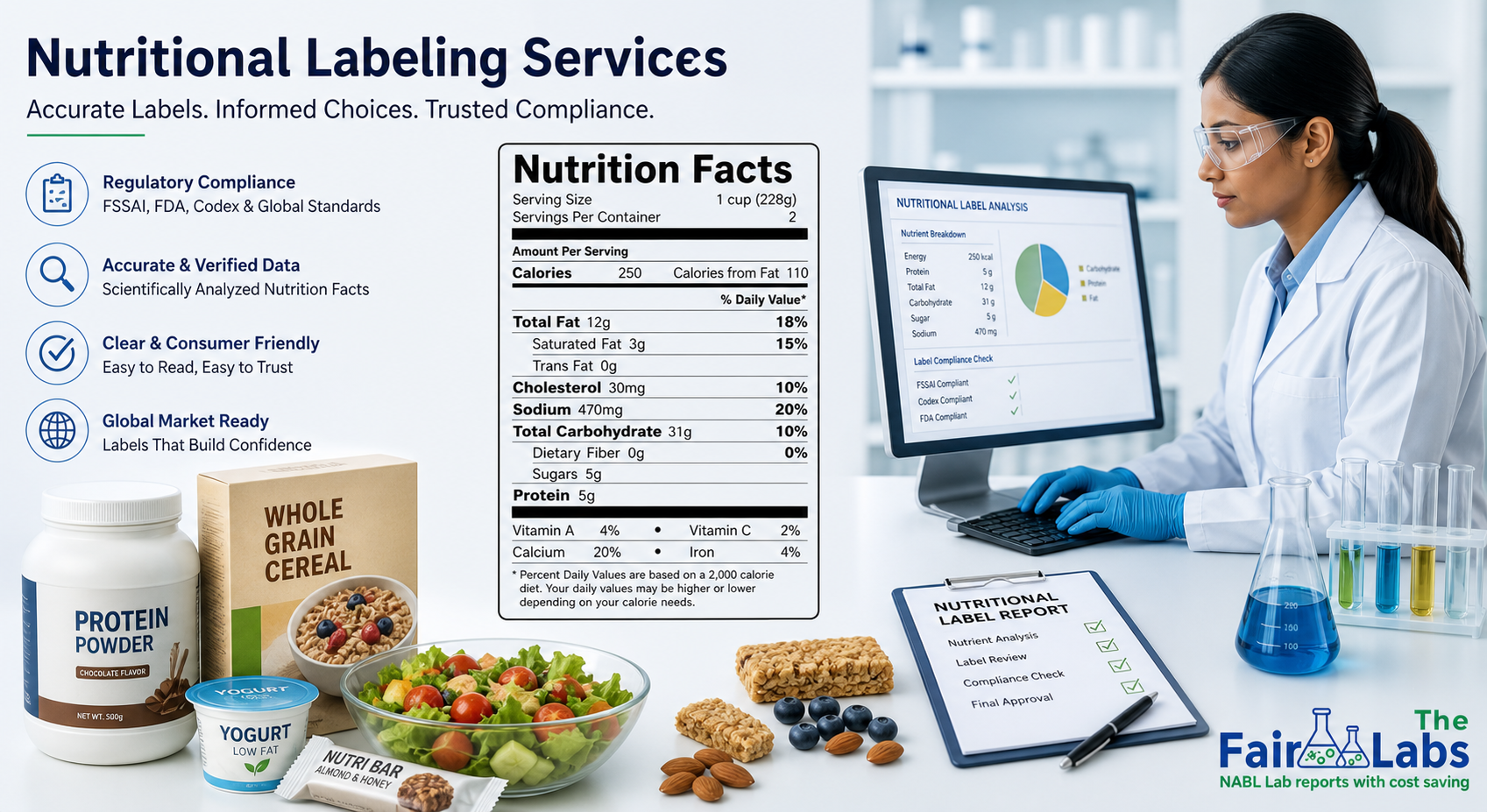
What is Nutritional Labeling?
Nutritional labeling is the process of determining a food product's nutritional composition through laboratory analysis and presenting that information in a standardized, regulation-compliant format on the product's packaging. A nutrition facts label typically includes energy value, protein, fat, carbohydrates, sugars, dietary fibre, and sodium content, along with any additional nutrients relevant to the product category or health claims being made.
It is important to understand why laboratory analysis — rather than calculation — forms the basis of a defensible label:
Every pre-packaged food product intended for retail sale in India is required to carry a nutrition facts label under FSSAI regulations, making accurate nutritional labeling a fundamental requirement for market entry. Nutrition labels also empower consumers to compare products, manage dietary needs, and make informed purchasing decisions — a responsibility that depends entirely on the accuracy of the underlying data.
Nutritional labeling combines scientific laboratory analysis with regulatory label preparation to produce nutrition facts panels that satisfy FSSAI requirements and withstand regulatory scrutiny.
Why Nutritional Labeling is Important
Nutritional labeling supports multiple critical business and compliance functions:
Quality & Compliance Benefits
- FSSAI Compliance — nutrition labels must comply with FSSAI's Food Safety and Standards (Labelling and Display) Regulations, which specify mandatory nutrients, format, rounding rules, and presentation requirements
- Consumer Trust — accurate labeling builds long-term consumer confidence in a brand's transparency and commitment to product quality
- Product Launch — a compliant nutrition label is a prerequisite for bringing any packaged food product to market in India
- Retail Acceptance — retailers and e-commerce platforms increasingly require verified, compliant nutrition labels before listing products
- Export Compliance — export-ready products require labels validated against both FSSAI and destination-market requirements
- Nutritional Claims — claims such as "low fat," "high protein," or "no added sugar" require laboratory substantiation and correct application of FSSAI's claims criteria
- Quality Assurance — nutrition labeling processes often surface formulation or process inconsistencies that might otherwise go unnoticed
- Regulatory Audits — laboratory-backed labels, supported by accredited test reports, provide the documentation needed during FSSAI inspections
- Brand Reputation — consistent, accurate labeling across a product portfolio reinforces brand credibility and reduces regulatory risk
Risks of Inaccurate Nutritional Labeling
- Incorrect nutrition labels leading to regulatory notices
- Regulatory penalties and enforcement action
- Product recalls and associated costs
- Retail and e-commerce listing rejection
- Consumer complaints and loss of trust
- Export shipment delays or rejection at destination markets
- Misleading health and nutrition claims
Nutritional Information Included on the Label
The Fair Labs quantifies both the mandatory core parameters and the optional declarations relevant to specific product categories or claims.
Mandatory Nutritional Parameters
- Energy (kcal) — total caloric value of the product
- Protein — quantified using validated protein-analysis methods
- Total Fat — overall fat content of the finished product
- Saturated Fat — fatty acid sub-declaration required under total fat
- Trans Fat — regulatory compliance and health-related declaration
- Carbohydrates — total carbohydrate content
- Total Sugars — sub-declaration under carbohydrates
- Added Sugars — sugars introduced during formulation
- Dietary Fibre — total fibre content of the product
- Sodium — mandatory mineral declaration
Optional Nutritional Information
- Vitamins — declared where relevant to formulation or fortification
- Minerals — beyond sodium, where product category requires it
- Cholesterol — relevant to certain fat-related claims
- Omega Fatty Acids — for functional food and nutraceutical positioning
- Amino Acids — relevant to protein-based and specialty products
- Specialty Nutritional Components — additional parameters specific to product category
Category- and Claim-Driven Declarations
Additional nutritional declarations may be required when a product carries specific health or nutrition claims, targets specialized categories such as infant nutrition or health supplements, or is destined for export markets with distinct labeling requirements. In these cases, parameters beyond the standard mandatory list — such as specific vitamins, minerals, or fatty acid breakdowns — must be laboratory-verified and declared accordingly.
Food Products We Support
Processed Foods
Packaged and formulated food products across categories
Dairy Products
Milk-based and fermented dairy formulations
Bakery Products
Bread, biscuits, cakes, and baked snacks
Snacks & Namkeen
Extruded, fried, and traditional savory snacks
Beverages
Functional drinks, juices, and beverage mixes
Nutraceuticals
Powders, capsules, gummies, and functional formulations
Health Supplements
Specialty and targeted nutrition products
Functional Foods
Products formulated around specific nutritional benefits
Infant Foods
Specialized formulations with dedicated labeling requirements
Ready-to-Eat Foods
Fully cooked, shelf-stable convenience products
Ready-to-Cook Foods
Pre-prepared mixes and semi-finished products
Imported & Export Products
Products requiring dual-market labeling alignment
Our Nutritional Labeling Services
Laboratory Nutritional Analysis
Comprehensive laboratory testing of a product's actual nutritional composition, covering energy, macronutrients, sugars, fibre, sodium, and additional parameters as required by product category or claims.
Nutrition Facts Label Preparation
Preparation of a compliant nutrition information panel based on validated laboratory data, formatted according to FSSAI's prescribed structure and presentation rules.
FSSAI Label Compliance Review
Verification of nutrition labels against current FSSAI Food Safety & Standards (Labelling and Display) Regulations to confirm mandatory declarations, rounding rules, and claims are correctly applied.
Label Verification
Review of existing labels prior to product launch to identify compliance gaps, outdated declarations, or inaccurate values before packaging is finalized.
Export Nutrition Label Support
Support for products intended for international markets, aligning nutrition declarations with destination-market labeling frameworks alongside FSSAI requirements.
Reformulation Support
Updating nutrition labels following recipe, formulation, or process changes to ensure the label continues to reflect the product's actual composition.
Laboratory Nutritional Analysis vs Nutrition Label Preparation
Businesses frequently confuse these two services, but they are distinct steps in the labeling process.
A business cannot skip laboratory analysis and go straight to label preparation, because there would be no verified data to populate the label. Equally, laboratory analysis alone does not produce a compliant label — the data must still be correctly formatted and reviewed against current regulations. The Fair Labs provides both services together, ensuring a seamless path from raw laboratory data to a print-ready, regulation-compliant nutrition facts panel.
Laboratory Parameters We Analyze
| Parameter | Purpose | Test Method | Importance |
|---|---|---|---|
| Energy Value | Calculates caloric content | Calculation from Macronutrients | Core mandatory label declaration |
| Protein | Quantifies protein content | Kjeldahl Method | Mandatory nutrition label parameter |
| Total Fat | Quantifies overall fat content | Soxhlet Extraction | Mandatory nutrition label parameter |
| Saturated Fat | Quantifies saturated fatty acid content | GC-FID | Mandatory sub-declaration under fat |
| Trans Fat | Quantifies trans fatty acid content | GC-FID | Regulatory compliance and health-related declaration |
| Carbohydrates | Quantifies total carbohydrate content | Calculation / AOAC Method | Mandatory nutrition label parameter |
| Total Sugars | Quantifies total sugar content | HPLC | Mandatory sub-declaration under carbohydrates |
| Added Sugars | Quantifies sugars added during formulation | HPLC / Formulation Review | Increasingly required regulatory declaration |
| Dietary Fibre | Quantifies total dietary fibre content | AOAC Enzymatic-Gravimetric Method | Mandatory nutrition label parameter |
| Sodium | Quantifies sodium content | Flame Photometry / AAS | Mandatory nutrition label parameter |
| Moisture | Determines moisture content | Gravimetric Drying | Supports accurate nutrient basis calculation |
| Ash | Determines inorganic residue content | Gravimetric Ashing | Supports overall compositional accuracy |
Laboratory-tested values for each of these parameters ensure that the final nutrition facts label reflects the product's true composition, reducing regulatory risk and strengthening consumer confidence in the accuracy of the declared information.
Laboratory Methods & Analytical Techniques
The Fair Labs applies internationally recognized analytical methods to generate reliable nutritional data for label preparation.
Internationally accepted analytical methods produce nutritional data that is reproducible, defensible during regulatory review, and consistent with the standards expected by retailers, regulators, and export markets alike.
Standards & Regulations We Follow
Laboratory-backed nutritional labeling improves regulatory acceptance because it demonstrates that declared values are supported by accredited testing rather than estimation, reducing the likelihood of compliance disputes and strengthening market credibility.
Industries We Serve
Our Nutritional Labeling Process
Why Choose The Fair Labs?
Related Services
- Macronutrient Analysis
- Dietary Fiber Analysis
- Vitamin & Mineral Profiling
- Fatty Acid Profiling
- Shelf Life Testing
- Food Adulteration Testing
- Food Label Verification
- Heavy Metal Testing
- Microbiological Testing