
Stability Chamber Studies Services in India
Product quality does not end at the manufacturing line — it is tested every single day the product sits on a shelf, in a warehouse, or inside a consumer's home. Temperature swings, humidity, light exposure, and time itself can quietly change a product's appearance, potency, safety, and performance long before its labelled expiry date. This is precisely why Stability Chamber Studies have become a non-negotiable part of product development, regulatory submission, and quality assurance across pharmaceuticals, food, nutraceuticals, cosmetics, and herbal industries.
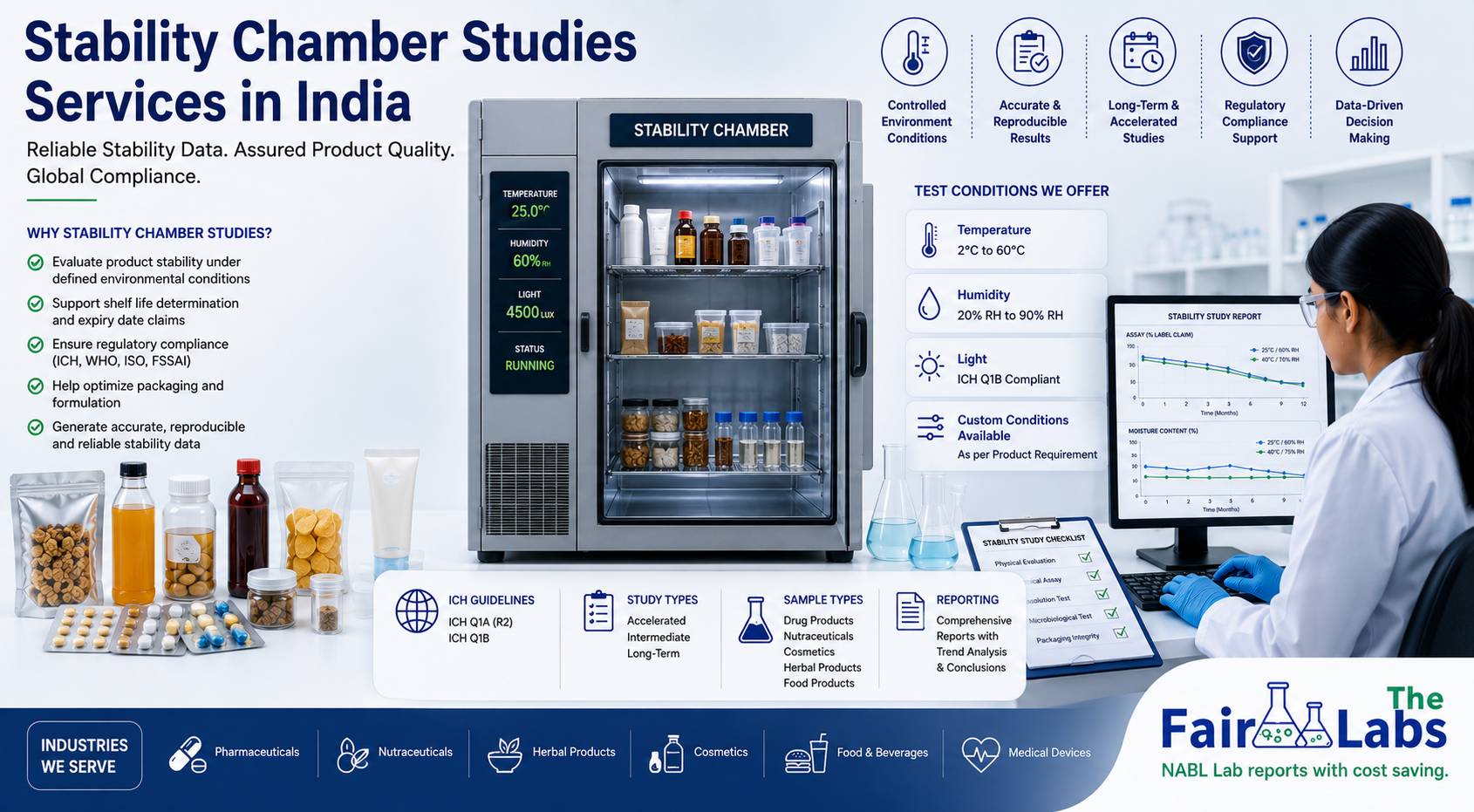
A Stability Chamber Study places a product under precisely controlled environmental conditions — temperature, relative humidity, and sometimes light — and monitors how it behaves over time. The results determine shelf life, validate packaging choices, confirm regulatory compliance, and ultimately protect the consumer who trusts the product on the shelf.
At The Fair Labs, we provide professional Stability Chamber Studies using internationally accepted testing methodologies and precisely controlled environmental chambers. Our studies are designed to help manufacturers, exporters, and R&D teams make confident decisions about shelf life, packaging, and formulation — backed by scientifically defensible, regulator-ready data.
Whether you are a pharmaceutical company preparing a regulatory dossier, a food manufacturer validating shelf life for a new product line, or a cosmetic brand confirming packaging compatibility, our stability testing programs are built around your product's real-world journey — from manufacturing to the moment it reaches the consumer.
Request Stability Study Quote →
What are Stability Chamber Studies?
Stability Chamber Studies are scientifically controlled experiments conducted inside specialized environmental chambers that maintain precise temperature and relative humidity conditions. The purpose is simple but critical: to observe how a product changes — physically, chemically, and microbiologically — when stored under specific environmental conditions over a defined period of time.
These studies help answer questions that directly affect product success in the market:
- How long will this product remain safe and effective?
- Will the packaging protect the product adequately?
- Does the formulation degrade under heat, humidity, or light?
- Will the product meet its labelled claims until the expiry date?
- Is the product ready for regulatory submission and market launch?
Stability chambers replicate a range of environmental scenarios — from standard room conditions to elevated temperature and humidity extremes — allowing manufacturers to generate reliable degradation data without waiting years for real-world results in every case.
Stability Chamber Studies vs. Shelf-Life Testing vs. Accelerated vs. Real-Time Studies
These terms are often used interchangeably, but each has a distinct meaning:
In practice, manufacturers use accelerated studies for early development decisions and regulatory filing support, while real-time studies confirm and validate the final shelf-life claim.
Why Stability Chamber Studies are Important
Stability testing is not a compliance formality — it is a scientific safeguard that protects your brand, your consumers, and your regulatory standing.
Business and Regulatory Importance
- Shelf-life validation: Establishes a scientifically justified expiry date rather than an estimated one.
- Product safety: Confirms that a product remains safe to consume or use throughout its stated shelf life.
- Product quality: Ensures appearance, potency, texture, and performance remain consistent over time.
- Regulatory approval: Required for pharmaceutical, food, cosmetic, and nutraceutical product registrations and licensing.
- Consumer confidence: Builds trust through consistent, reliable product performance.
- Product development support: Guides formulation scientists in selecting stable ingredients and combinations.
- Packaging validation: Confirms that chosen packaging materials protect the product adequately.
- Export compliance: Many international markets require stability data before allowing product entry.
- Manufacturing quality systems: Supports GMP and quality management documentation.
Risks of Skipping Stability Studies
Without proper stability data, manufacturers expose themselves to serious risks, including:
- Product degradation before the labelled expiry date
- Loss of potency in pharmaceuticals and nutraceuticals
- Microbial growth and contamination risk
- Packaging failure, leakage, or seal breakdown
- Unexpected colour or odour changes
- Texture separation or physical instability
- Product recalls and associated financial loss
- Increased customer complaints
- Regulatory non-compliance, license suspension, or rejection of export shipments
A single stability failure discovered post-launch can be far costlier — financially and reputationally — than the investment required for proper testing upfront.
Types of Stability Studies We Offer
Real-Time Stability Studies
Real-time stability studies store products under their actual, intended storage conditions — typically room temperature or the labelled storage condition — for the full duration of the proposed shelf life. This is considered the gold standard for shelf-life determination because it reflects genuine, real-world conditions rather than simulated stress.
Real-time data is generally required by regulatory authorities to confirm final shelf-life claims and is essential for product labelling and market authorization.
Accelerated Stability Studies
Accelerated stability studies expose products to elevated temperature and higher relative humidity than normal storage conditions. By stressing the product, degradation reactions occur faster, allowing scientists to predict long-term stability within a much shorter testing window.
This approach is particularly valuable during product development, formulation screening, and preliminary regulatory submissions, where waiting for full real-time data is not practical.
Intermediate Stability Studies
Intermediate stability studies are conducted under conditions that sit between long-term and accelerated parameters. They are typically required when a product shows significant change under accelerated conditions, acting as a bridge to clarify whether the observed degradation is a genuine long-term risk or simply a consequence of the higher stress conditions.
Photostability Studies
Photostability studies evaluate how a product responds to light exposure, including UV and visible light. This is particularly important for:
- Products sensitive to light-induced degradation
- Formulations containing light-reactive active ingredients
- Validating whether packaging (bottles, blister packs, cartons) adequately protects the product from light
Photostability testing ensures that packaging design decisions are backed by real evidence of light protection, not assumption.
In-Use Stability Studies
Many products are not used in a single sitting — they are opened, partially used, and stored again, sometimes for weeks or months. In-Use Stability Studies simulate this real consumer behaviour by testing the product after the container has been opened and is subject to repeated exposure to air, moisture, and handling.
This is especially relevant for multi-dose pharmaceuticals, cosmetics, syrups, and liquid formulations where the "in-use period" after first opening is a critical safety and quality parameter.
Products We Test
Our Stability Chamber Studies support a wide range of product categories:
Food Products
- Processed Foods
- Dairy Products
- Bakery Products
- Snacks
- Beverages
- Functional Foods
Nutraceuticals
- Tablets
- Capsules
- Powders
- Syrups
- Gummies
Pharmaceuticals
- Tablets
- Capsules
- Injectables
- Suspensions
- Ointments
- Creams
Cosmetics
- Creams
- Lotions
- Face Wash
- Shampoo
- Oils
- Serums
Herbal & Ayurvedic Products
- Powders
- Tablets
- Capsules
- Syrups
- Oils
Stability Parameters We Evaluate
| Parameter | Purpose | Evaluation Method | Importance |
|---|---|---|---|
| Appearance | Detects visible physical change | Visual inspection under standard lighting | Early indicator of degradation |
| Colour | Identifies colour shift or fading | Visual/colorimetric assessment | Reflects chemical stability |
| Odour | Detects off-notes or rancidity | Sensory evaluation | Signals oxidation or spoilage |
| Texture | Assesses consistency changes | Physical/sensory testing | Affects usability and quality perception |
| Viscosity | Measures flow behaviour changes | Viscometry | Critical for liquids, creams, syrups |
| Moisture Content | Detects moisture gain/loss | Karl Fischer / gravimetric analysis | Impacts microbial risk and texture |
| pH | Monitors acid-base balance | pH meter analysis | Affects stability and preservative efficacy |
| Assay | Confirms active ingredient concentration | HPLC / titration | Ensures label claim accuracy |
| Active Ingredient Stability | Tracks potency over time | Chromatographic analysis | Core to efficacy and safety |
| Oxidation | Detects oxidative degradation | Peroxide value / chemical assays | Prevents rancidity and potency loss |
| Hydrolysis | Identifies breakdown via moisture reaction | Chemical analysis | Common degradation pathway |
| Total Plate Count | Assesses microbial load | Microbiological culture | Ensures microbial safety |
| Yeast & Mould | Detects fungal contamination | Microbiological culture | Prevents spoilage and health risk |
| Pathogen Detection | Screens for harmful organisms | Microbiological testing | Critical for consumer safety |
| Preservative Effectiveness | Confirms preservative system performance | Challenge testing | Ensures long-term microbial protection |
| Container Integrity | Assesses structural soundness | Physical inspection | Prevents contamination and leakage |
| Seal Integrity | Confirms closure performance | Seal/leak testing | Maintains product protection |
| Leakage | Detects packaging failure | Pressure/vacuum testing | Prevents product loss and contamination |
| Compatibility | Confirms product-package interaction | Extended storage observation | Prevents packaging-induced degradation |
| Label Durability | Assesses label adhesion and legibility | Physical/environmental exposure testing | Ensures regulatory and consumer information integrity |
Stability Chamber Conditions
| Study Type | Temperature | Relative Humidity | Typical Duration |
|---|---|---|---|
| Long-Term Studies | 25°C ± 2°C | 60% RH ± 5% | 12–36 months |
| Intermediate Studies | 30°C ± 2°C | 65% RH ± 5% | 6–12 months |
| Accelerated Studies | 40°C ± 2°C | 75% RH ± 5% | 3–6 months |
| Refrigerated Products | 5°C ± 3°C | Not controlled | As per product profile |
| Frozen Products | -20°C ± 5°C | Not controlled | As per product profile |
Note: Study conditions may vary depending on product type, formulation category, packaging system, and applicable regulatory guidelines (ICH climatic zones, product-specific requirements, or country-specific norms). Our technical team designs each protocol based on the specific product and its intended market.
Standards & Guidelines We Follow
The Fair Labs conducts Stability Chamber Studies in alignment with globally and nationally recognized frameworks, including:
Following internationally accepted stability protocols is not just about compliance — it ensures that shelf-life claims are scientifically defensible, reproducible, and accepted by regulatory bodies, auditors, and international trade partners. It also protects your business from the risk of rejected submissions or shipment holds during export.
Laboratory Equipment & Testing Capabilities
Reliable stability data depends on precise environmental control and accurate analytical testing. The Fair Labs is equipped with:
This combination of controlled environmental systems and advanced analytical instrumentation ensures that every stability study we conduct produces precise, reproducible, and regulator-ready results.
Industries We Serve
Our Stability Study Process
Why Choose The Fair Labs?
Related Testing Services
- Shelf-Life Testing
- Food Testing
- Nutritional Analysis
- Microbiological Testing
- Packaging Testing
- Water Testing
- Environmental Testing
- Product Validation
- Laboratory Testing Services