
Cosmetics and Personal Care Testing in India
Cosmetic and personal care products are applied directly to skin, hair, and sensitive areas of the body, often daily and over long periods of time. That direct, repeated contact places consumer safety at the center of every formulation decision — and makes laboratory testing a non-negotiable step before any product reaches the market. Beyond safety, today's consumers expect performance, stability, and transparency, while regulators require documented proof that products meet prescribed safety and quality standards.
From microbiological safety and heavy metal limits to stability under real-world storage conditions and performance claims like SPF or moisturizing efficacy, cosmetic and personal care testing verifies that a product is safe to use, performs as promised, and remains stable throughout its shelf life. For brands preparing to launch domestically or export internationally, this testing also forms the documented evidence base required for regulatory approval under BIS, CDSCO, and international frameworks.
The Fair Labs provides professional Cosmetics and Personal Care Testing using internationally accepted analytical methods and advanced laboratory instrumentation. Our NABL-accredited laboratory supports skincare, haircare, beauty, and personal care brands across India with rigorous testing that protects consumers, strengthens brand reputation, and ensures regulatory and export readiness.
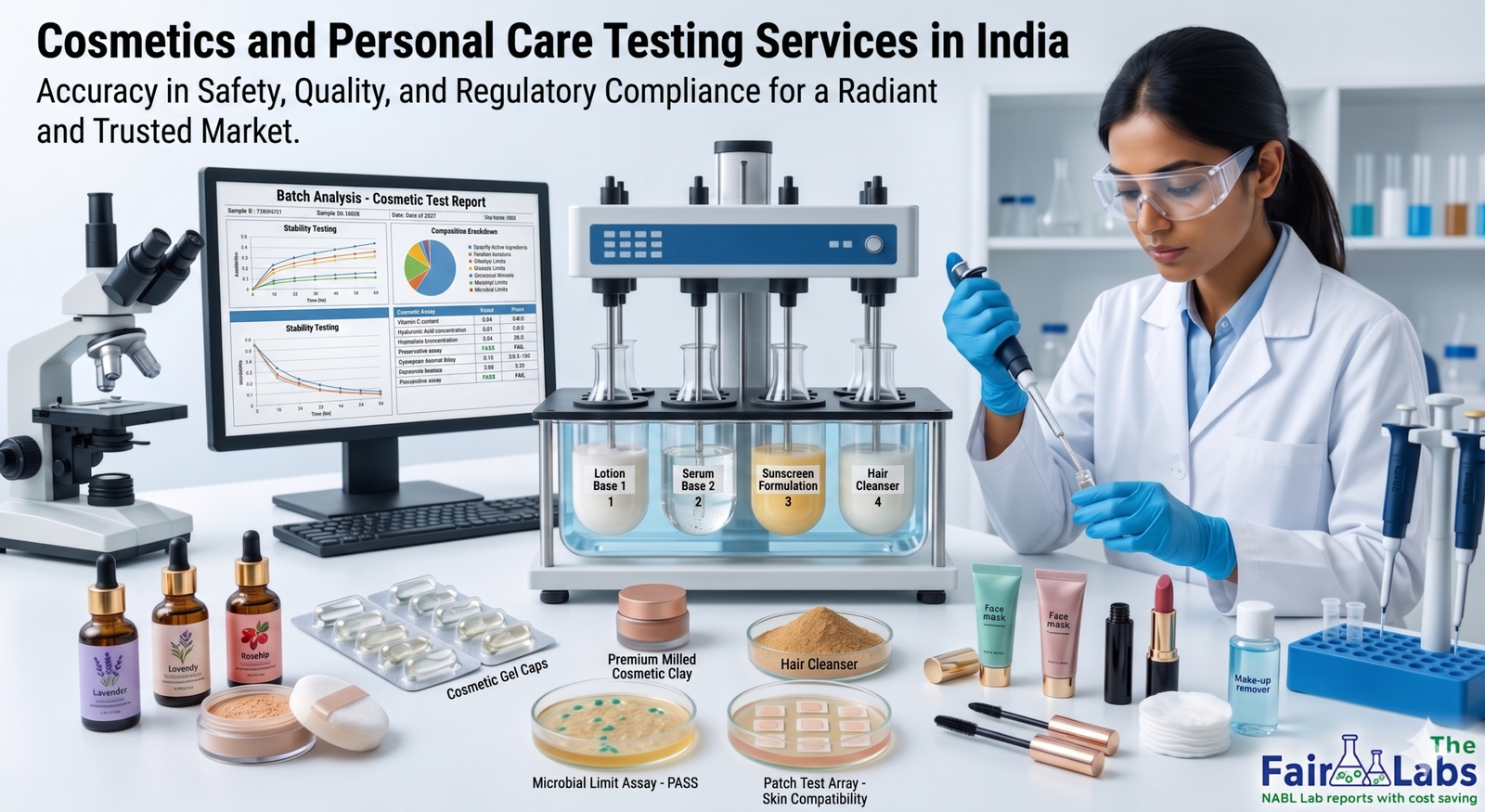
What is Cosmetics and Personal Care Testing?
Cosmetics and personal care testing is the laboratory evaluation of cosmetic products to verify their safety, quality, stability, and performance before they reach consumers. It encompasses microbiological testing, chemical analysis, physical characterization, stability studies, and performance evaluation, all conducted using validated analytical methods.
It is important to understand the distinction between cosmetic and pharmaceutical testing:
Laboratory testing confirms that a cosmetic product is free from harmful levels of contaminants, formulated within safe chemical limits, microbiologically safe for use, and stable throughout its intended shelf life. Testing before launch identifies safety, stability, or quality issues while they can still be corrected — protecting both consumers and the brand from costly post-launch failures.
International markets impose their own cosmetic safety and labeling requirements. Export-ready products require laboratory data validated against both Indian and destination-market regulatory standards. Laboratory test reports provide the documented evidence needed to demonstrate compliance with BIS standards, CDSCO guidelines, and the Cosmetics Rules, 2020, during regulatory review or market surveillance.
Why Cosmetics Testing is Important
Cosmetics and personal care testing supports multiple critical business and compliance functions:
Quality & Compliance Benefits
- Consumer Safety — identifies harmful microorganisms, restricted chemicals, and heavy metals before a product reaches consumers
- Product Quality — consistent quality testing confirms that formulations meet internal specifications batch after batch
- BIS Compliance — Indian Standards published by the Bureau of Indian Standards prescribe specific safety and quality parameters for various cosmetic product categories
- CDSCO Regulatory Requirements — the Central Drugs Standard Control Organisation oversees cosmetic regulation in India, and laboratory testing supports compliance with its guidelines
- Export Compliance — export shipments require validated laboratory data aligned with the safety and labeling requirements of destination markets
- Shelf Life Validation — stability testing determines how long a product remains safe and effective under intended storage and usage conditions
- Product Performance — performance testing verifies that claims such as moisturizing efficacy, SPF protection, or cleansing performance are scientifically substantiated
- Brand Reputation — rigorously tested products reduce the risk of safety incidents that could damage consumer trust and brand equity
- Quality Assurance — routine testing across the product lifecycle confirms that raw material and process variability have not compromised product safety or quality
- Product Consistency — testing verifies that products maintain consistent appearance, texture, and performance across production batches
Risks of Skipping Cosmetic Testing
- Skin irritation and adverse reactions
- Allergic reactions among sensitive consumers
- Microbial contamination compromising product safety
- Product recalls and associated costs
- Regulatory action under the Drugs & Cosmetics Act
- Customer complaints and negative reviews
- Long-term loss of brand reputation
Quality, Safety, Stability & Regulatory Compliance Testing: Understanding the Difference
Many cosmetic businesses use these terms interchangeably, but each addresses a distinct question about the product.
Quality Testing
Verifies that a product meets its internal formulation specifications — checking parameters like appearance, viscosity, pH, and active ingredient content to confirm batch-to-batch consistency.
Safety Testing
Evaluates whether a product is safe for consumer use, covering microbiological safety, heavy metals, restricted chemicals, and preservative effectiveness to identify risks of irritation, contamination, or toxicity.
Stability Testing
Determines how a product behaves over time and under varying storage conditions, establishing shelf life and confirming that safety and performance are maintained until the point of use.
Regulatory Compliance Testing
Confirms that a product meets the specific parameters and limits prescribed by applicable regulations — such as BIS standards, the Cosmetics Rules, 2020, and CDSCO guidelines — providing the documented evidence needed for legal market entry.
A product can pass quality testing yet still fail a regulatory limit, or remain stable while containing a restricted chemical. A complete testing program addresses all four dimensions together, which is why The Fair Labs structures its cosmetic testing services to cover quality, safety, stability, and regulatory compliance as an integrated process rather than isolated checks.
Cosmetic & Personal Care Products We Test
Skin Care
Face Creams, Moisturizers, Face Washes, Cleansers, Serums, Sunscreens, Lotions, Body Butter, Face Masks
Hair Care
Shampoo, Conditioner, Hair Oil, Hair Serum, Hair Masks, Hair Styling Products
Personal Care
Soap, Body Wash, Hand Wash, Deodorants, Talcum Powder, Wet Wipes
Beauty Products
Lipsticks, Foundations, Compact Powders, Kajal, Mascara, Eyeliners, Blush, Makeup Primers
Herbal & Ayurvedic Cosmetics
Testing tailored to formulations using natural and herbal ingredients, verifying safety and consistency alongside traditional claims
Baby Care Products
Testing with heightened scrutiny given the sensitivity of the target consumer group
Men's Grooming Products
Testing across shaving, skincare, and grooming formulations designed for this growing product category
Testing Parameters
Microbiological Testing
Microbiological safety is essential because contaminated cosmetic products can cause skin infections, irritation, and other adverse health effects, particularly in products used near the eyes, on broken skin, or on infants.
- Total Microbial Count — quantifies overall microbial load in a product
- Yeast & Mould — detects fungal contamination
- Pathogen Detection — screens for specific harmful microorganisms
- Preservative Effectiveness — verifies that a product's preservative system adequately controls microbial growth over its shelf life
Chemical Testing
- pH — confirms formulation is within a skin-compatible range
- Heavy Metals — screens for lead, arsenic, mercury, and other restricted contaminants
- Preservative Analysis — quantifies preservative levels against permitted limits
- Restricted Chemicals — screens for substances prohibited or limited under cosmetic regulations
- Formaldehyde — detects formaldehyde and formaldehyde-releasing preservatives
- Alcohol Content — quantifies alcohol levels relevant to formulation and labeling
- Active Ingredients — verifies concentration of key functional ingredients
Physical Testing
- Appearance — visual assessment of the finished product
- Colour — verifies consistency against formulation specification
- Odour — assesses fragrance and detects off-notes
- Viscosity — measures flow characteristics relevant to product texture and dispensing
- Density — confirms formulation consistency
- Texture — evaluates sensory feel and consistency
- Spreadability — assesses ease of application, particularly for creams and lotions
Stability Testing
- Accelerated Stability — evaluates product behavior under elevated temperature and humidity to predict long-term stability
- Real-Time Stability — monitors product performance under normal storage conditions over an extended period
- Packaging Compatibility — confirms the product does not degrade or interact adversely with its packaging
- Temperature Stability — assesses performance across a range of storage and transport temperatures
- Shelf Life Evaluation — determines the period during which a product remains safe and effective
Performance Testing
- Moisturizing Efficiency — measures hydration performance of skincare formulations
- SPF Verification — where applicable, verifies sun protection factor claims
- Cleansing Performance — evaluates effectiveness of cleansing formulations
- Foam Stability — assesses foam generation and persistence in wash-off products
- Product Consistency — confirms uniform performance across batches
Laboratory Parameters
| Parameter | Purpose | Analytical Method | Importance |
|---|---|---|---|
| pH | Confirms skin-compatible formulation | pH Meter | Affects safety and product stability |
| Viscosity | Measures flow and consistency | Viscometer | Relevant to texture, dispensing, and quality control |
| Heavy Metals | Screens for restricted contaminants | ICP-MS | Critical consumer safety parameter |
| Microbial Count | Quantifies microbial load | Microbiological Culture Methods | Core microbiological safety indicator |
| Preservative Content | Verifies preservative concentration | HPLC | Ensures effective, compliant preservation |
| Active Ingredient Analysis | Confirms concentration of functional ingredients | HPLC / GC-MS | Validates formulation and label claims |
| Stability | Assesses product behavior over time | Accelerated & Real-Time Stability Studies | Determines shelf life and safety over time |
| Appearance | Visual quality check | Visual & Instrumental Assessment | Confirms formulation consistency |
| Density | Confirms formulation uniformity | Density Meter / Pycnometer | Supports quality control and packaging accuracy |
| Packaging Compatibility | Assesses product-packaging interaction | Compatibility Studies | Prevents degradation and contamination risk |
These parameters, taken together, provide a complete and scientifically robust picture of a product's safety, quality, and performance profile, supporting both regulatory declarations and formulation decisions.
Laboratory Methods & Instrumentation
The Fair Labs maintains advanced instrumentation to support comprehensive cosmetic testing.
Validated laboratory methods improve product safety and regulatory confidence by ensuring that results are accurate, reproducible, and consistent with the standards expected by regulators, retailers, and international buyers.
Standards & Regulations We Follow
Laboratory testing supports regulatory approval and market acceptance by providing accredited, documented evidence that a product meets the safety and quality standards required by regulators, retailers, and international trade partners.
Industries We Serve
Our Testing Process
Why Choose The Fair Labs?
Related Testing Services
- Stability Chamber Studies
- Shelf Life Testing
- Microbiological Testing
- Heavy Metal Testing
- Packaging Material Testing
- Overall Migration Testing
- Specific Migration Testing
- Water Testing
- Chemical Testing