
Shelf Life Testing Services in India
Every product that reaches a consumer's hands carries an implicit promise: that it will remain safe, effective, and enjoyable to use until the date printed on its label. Determining that date correctly is not guesswork — it is a scientific process. Accurate shelf life testing protects product safety, preserves product quality, builds consumer confidence, ensures regulatory compliance, validates packaging performance, confirms storage stability, and ultimately supports a defensible, evidence-based expiry date.
The Fair Labs provides professional Shelf Life Testing using scientific protocols, controlled environmental conditions, microbiological analysis, chemical evaluation, and structured stability studies. Our laboratory helps food manufacturers, beverage brands, nutraceutical companies, dietary supplement producers, and herbal product manufacturers establish accurate, regulator-ready shelf life data — whether for a new product launch, a reformulation, or an export shipment requiring documented stability evidence.
Shelf life testing is not an optional formality. It is the scientific foundation on which your product's expiry date claim, packaging strategy, and consumer trust are built.
Request Shelf Life Testing Quote →
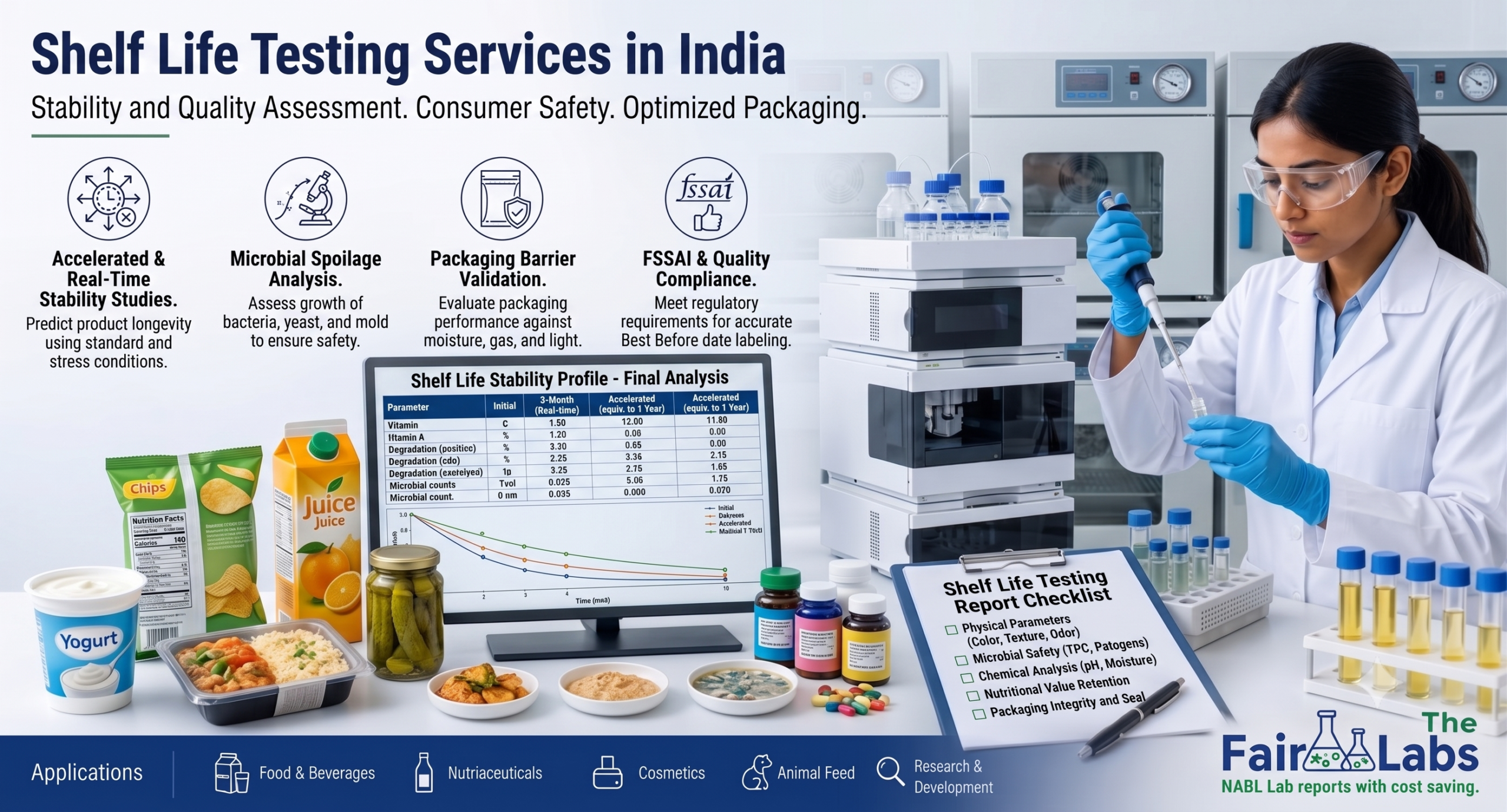
What is Shelf Life Testing?
Shelf life testing is the scientific process of evaluating how a product's physical, chemical, microbiological, and sensory properties change over time, in order to determine the period during which it remains safe, stable, and acceptable for consumer use. The result of this process is the expiry or "best before" date displayed on the product label.
What Determines Product Shelf Life?
A product's shelf life is influenced by multiple interacting factors, including:
- Formulation and ingredient composition
- Manufacturing and processing methods
- Packaging material and format
- Storage and distribution conditions
- Microbiological load and preservation system
- Chemical stability of active or sensitive ingredients
Because these factors interact differently for every formulation and packaging combination, shelf life cannot be reliably estimated from assumptions or industry averages — it must be established through structured laboratory testing.
Shelf Life Testing vs. Stability Testing
The terms are closely related but not identical. Stability testing is the broader scientific discipline of evaluating how a product's properties change under defined environmental conditions. Shelf life testing is the applied outcome of stability testing — using stability data to determine and validate the specific expiry period assigned to a product. In practice, a shelf life study is a structured stability testing program designed specifically to establish an expiry date.
Real-Time vs. Accelerated Studies
Shelf life testing can be approached in two complementary ways:
Why Laboratory Testing Is Essential
Estimating an expiry date based on similar products, industry norms, or assumption is a significant business and consumer risk. Laboratory-based shelf life testing provides:
- Objective, measurable evidence of product behaviour over time
- Scientific justification for label claims
- Defensible documentation for regulatory and export requirements
- Early identification of formulation or packaging weaknesses
A validated shelf life is not just a compliance requirement — it is a scientifically earned claim that protects both your consumers and your business.
Why Shelf Life Testing is Important
Shelf life testing plays a foundational role across nearly every dimension of product quality and business operations:
Business and Regulatory Importance
- Food Safety — confirms products remain microbiologically safe throughout their labelled life
- Product Quality — verifies taste, texture, appearance, and functionality are maintained
- Consumer Satisfaction — reduces the risk of spoiled or degraded products reaching customers
- Regulatory Compliance — supports adherence to food safety and labelling regulations
- FSSAI Compliance — meets Indian regulatory expectations for expiry date substantiation
- Export Requirements — satisfies international buyer and customs documentation needs
- Product Development — informs formulation, ingredient, and process decisions
- Packaging Validation — confirms that chosen packaging adequately protects the product
- Quality Assurance — provides ongoing verification of product consistency
- Brand Reputation — builds long-term consumer and retailer trust
- Inventory Management — supports accurate stock rotation and distribution planning
- Reduced Product Recalls — minimizes the risk of costly, reputation-damaging recalls
Risks of Skipping Proper Shelf Life Testing
- Incorrect or unsupported expiry dates
- Premature spoilage before the labelled expiry
- Increased customer complaints
- Product recalls and associated costs
- Direct financial losses from wasted stock
- Regulatory non-compliance and potential penalties
- Export shipment rejection at customs or by international buyers
- Long-term damage to brand credibility
Products We Test
Food Products
Snacks, Bakery Products, Ready-to-Eat Foods, Ready-to-Cook Foods, Processed Foods, Frozen Foods, Dairy Products, Confectionery, Oils, Sauces, Pickles, Condiments, Spices
Beverages
Fruit Juices, Carbonated Drinks, Dairy Beverages, Functional Drinks, Energy Drinks, Bottled Water
Nutraceutical Products
Protein Powders, Capsules, Tablets, Gummies, Liquid Supplements
Herbal Products
Powders, Capsules, Syrups, Oils, Herbal Formulations
Shelf Life Parameters We Evaluate
| Parameter | Purpose | Test Method | Importance |
|---|---|---|---|
| Microbiological Quality | Confirm safety and hygiene over time | Culture-based microbiological testing | Prevents spoilage and safety risks |
| Moisture Content | Track hydration/dryness changes | Moisture analyzer | Affects texture and microbial stability |
| Water Activity (Aw) | Predict microbial growth potential | Water activity meter | Key predictor of spoilage susceptibility |
| pH | Detect chemical/fermentation shifts | pH meter | Affects safety and preservation efficacy |
| Acidity | Monitor acid-related changes | Titration | Impacts taste and microbial control |
| Oxidative Stability | Assess fat/oil degradation | Peroxide value analysis | Prevents rancidity and off-flavours |
| Rancidity | Detect fat breakdown | Sensory and chemical testing | Impacts taste, safety, and acceptability |
| Sensory Evaluation | Confirm consumer-facing quality | Trained sensory panel | Validates real-world acceptability |
| Colour Stability | Track visual degradation | Colorimeter/visual assessment | Indicator of chemical or oxidative change |
| Texture Analysis | Monitor consistency changes | Texture analyzer | Affects usability and perception |
| Nutritional Stability | Track nutrient degradation | Analytical assay | Supports nutritional label claims |
| Packaging Integrity | Confirm ongoing product protection | Seal, leak, and compatibility testing | Prevents contamination and spoilage |
| Preservative Effectiveness | Confirm ongoing antimicrobial protection | Challenge testing | Validates formulation safety over time |
Collectively, these parameters determine the point at which a product no longer meets its intended safety, quality, or sensory standards — establishing the scientific basis for the assigned shelf life.
Types of Shelf Life Studies
Real-Time Shelf Life Study
Real-time shelf life studies store products under their actual recommended storage conditions and monitor quality at scheduled intervals across the full intended shelf life. This approach offers:
- Evaluation under true, real-world storage conditions
- The most accurate and defensible expiry date determination
- Long-term monitoring that captures genuine degradation patterns
- The highest level of reliability for final product claims
Real-time studies are the preferred method for confirming final shelf life claims, regulatory submissions, and export documentation.
Accelerated Shelf Life Study
Accelerated shelf life studies expose products to elevated temperature and humidity conditions to speed up degradation reactions and predict shelf life more quickly. This approach offers:
- Faster preliminary shelf life estimates
- Support for early-stage product development decisions
- Efficient comparison between formulation or packaging alternatives
- Useful screening data ahead of full real-time confirmation
When to Use Each Approach
Accelerated studies are best suited to early product development, formulation screening, and rapid comparative assessment, where speed is a priority and a preliminary estimate is sufficient. Real-time studies are essential when a manufacturer needs final, confirmatory data to support an actual label claim, regulatory filing, or export requirement. In many cases, manufacturers use accelerated data during development and real-time data for final validation — combining speed and confidence at different stages of the product lifecycle.
Laboratory Methods & Testing Capabilities
The Fair Labs maintains a comprehensive testing infrastructure to support accurate, reliable shelf life testing:
These combined methods provide scientifically reliable, cross-validated shelf life data — rather than relying on any single test in isolation.
Standards & Guidelines We Follow
The Fair Labs designs and conducts shelf life testing in alignment with recognized national and international frameworks, including:
Scientifically validated shelf life studies, conducted under these frameworks, strengthen regulatory compliance and build lasting consumer confidence in your product's expiry date claims.
Industries We Serve
Our Shelf Life Testing Process
Why Choose The Fair Labs?
Related Testing Services
- Real Time Shelf Life Studies
- Stability Chamber Studies
- Microbiological Spoilage Analysis
- Food Microbiological Testing
- Packaging Testing
- Water Testing
- Food Safety Testing
- Nutritional Analysis
- Product Stability Testing