
Real Time Shelf Life Studies Services in India
Determining an accurate shelf life is one of the most critical steps in bringing any food, beverage, nutraceutical, pharmaceutical, cosmetic, or herbal product to market. An incorrect expiry date can compromise consumer safety, trigger product recalls, invite regulatory action, and permanently damage brand trust. A scientifically validated shelf life gives your business the confidence to make label claims, plan production and distribution, and enter competitive retail and export markets with credibility.
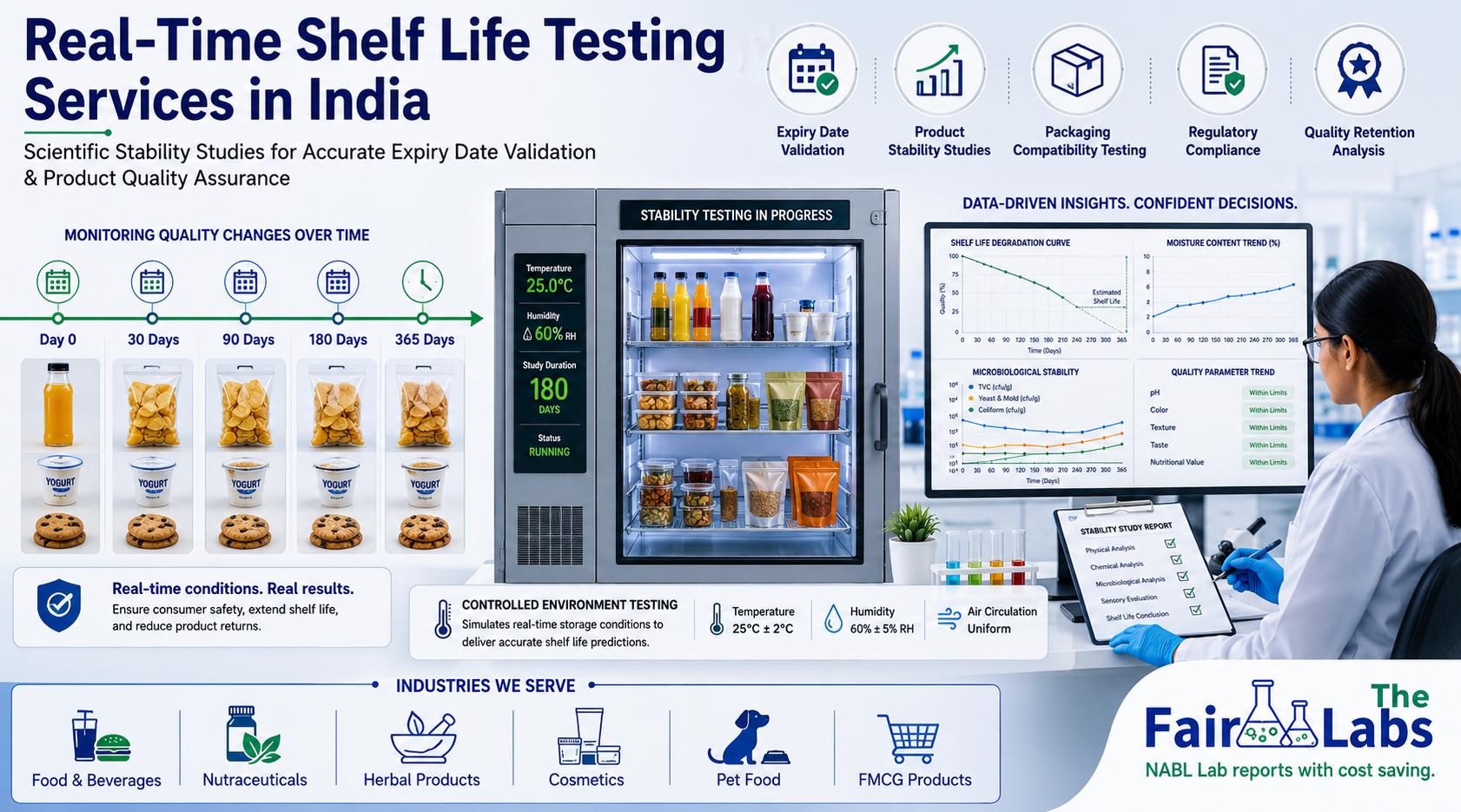
Real Time Shelf Life Studies are the gold standard for expiry date validation. Unlike predictive or accelerated methods, real time studies monitor a product's quality, safety, and stability under its actual recommended storage conditions, over the entire duration of its intended shelf life. This approach produces the most reliable, defensible, and regulator-accepted evidence of how a product behaves in the real world — from the day it is manufactured to the day it reaches the end of its labelled shelf life.
At The Fair Labs, we provide professional Real Time Shelf Life Studies using controlled environmental conditions, validated analytical methods, and scientifically designed study protocols. Our laboratory combines NABL-accredited testing capabilities with experienced stability scientists to help food manufacturers, beverage brands, nutraceutical companies, pharmaceutical manufacturers, cosmetic producers, and herbal product companies establish accurate, regulator-ready shelf life data.
Whether you are launching a new product, revalidating an existing formulation, entering export markets, or responding to a regulatory query, The Fair Labs delivers the scientific evidence you need to support your expiry date claims with confidence.
Request Shelf Life Study Quote →
What are Real Time Shelf Life Studies?
Real Time Shelf Life Studies (also called real-time stability studies) are structured, long-duration testing programs in which a product is stored under the exact conditions recommended on its label — such as ambient room temperature, refrigeration, or frozen storage — and evaluated at scheduled intervals across its intended shelf life. The purpose is to observe how the product's physical, chemical, and microbiological attributes actually change over time, rather than predicting that change through accelerated mathematical models.
The core objectives of a real time shelf life study include:
- Establishing scientifically validated expiry dates
- Monitoring product quality, safety, and efficacy throughout storage
- Verifying that packaging continues to protect the product over time
- Generating data to support label claims and regulatory submissions
- Reducing commercial risk before large-scale product launch
Because real time studies reflect true storage conditions, they are widely regarded by regulators and quality professionals as the most trustworthy method of shelf-life determination — particularly for final product commercialization and regulatory filings.
Real Time Shelf Life Studies vs. Accelerated Stability Studies
| Aspect | Real Time Shelf Life Studies | Accelerated Stability Studies |
|---|---|---|
| Storage Conditions | Actual recommended storage conditions | Elevated temperature/humidity to speed degradation |
| Duration | Matches the full intended shelf life (months to years) | Shorter duration (weeks to a few months) |
| Purpose | Final, confirmatory shelf-life validation | Preliminary/predictive estimate, early-stage screening |
| Regulatory Acceptance | Highest level of confidence; often mandatory for final claims | Supportive data; usually not sufficient alone |
| Best Used For | Final product launch, label claims, export documentation | R&D screening, formulation comparison, early risk assessment |
Real Time Shelf Life Studies vs. Stability Chamber Studies
Stability chamber studies refer to the use of controlled environmental chambers to simulate specific temperature and humidity conditions — these chambers are the equipment used to conduct both real time and accelerated studies. In other words, a stability chamber is the tool; real time and accelerated studies are the methodologies. At The Fair Labs, our stability chambers are calibrated and monitored to replicate precise ambient, refrigerated, or climatic conditions required for accurate real-time evaluation.
Product Stability Testing and Expiry Date Validation
Product stability testing is the broader scientific discipline encompassing physical, chemical, and microbiological evaluation of a product over time. Expiry date validation is the outcome of this testing — the scientifically supported date beyond which a manufacturer can no longer assure the stated quality, safety, or efficacy of the product. Real Time Shelf Life Studies are the most direct and reliable pathway to sound expiry date validation.
Why Real Time Shelf Life Studies are Important
An accurately validated shelf life protects your consumers, your regulatory standing, and your brand. Real time studies matter because they directly influence:
Business and Regulatory Importance
- Accurate expiry date determination — grounded in observed, real-world product behaviour rather than prediction
- Consumer safety — ensuring products remain safe to consume or use throughout their labelled life
- Product quality — confirming taste, texture, potency, and appearance hold up as promised
- Regulatory compliance — meeting FSSAI, ICH, WHO, and other applicable requirements
- Packaging validation — verifying that containers and closures continue to protect the product
- Product development — informing formulation and packaging decisions before scale-up
- Brand credibility — building consumer and retailer trust through verified claims
- Export readiness — satisfying international buyer and regulatory documentation requirements
- Retail acceptance — meeting distributor and retailer shelf-life documentation standards
Risks of Skipping Proper Shelf Life Validation
Without robust real time shelf-life data, manufacturers expose themselves to significant risk, including:
- Incorrect or unsupported expiry dates
- Premature product spoilage
- Nutrient or active ingredient degradation
- Loss of potency in nutraceutical and pharmaceutical products
- Microbial contamination during the labelled shelf life
- Packaging failure, leakage, or seal breakdown
- Costly product recalls
- Increased customer complaints and returns
- Regulatory action, penalties, or product bans
Investing in a properly designed real time shelf life study is a proactive safeguard against each of these outcomes.
Products We Test
The Fair Labs conducts Real Time Shelf Life Studies across a wide range of product categories.
Food Products
Ready-to-Eat Foods, Dairy Products, Bakery Products, Snacks, Frozen Foods, Spices, Processed Foods
Beverages
Juices, Soft Drinks, Energy Drinks, Functional Beverages, Tea & Coffee Products
Nutraceuticals
Tablets, Capsules, Gummies, Powders, Syrups
Pharmaceuticals
Tablets, Capsules, Creams, Ointments, Liquid Formulations
Cosmetics & Personal Care
Creams, Lotions, Serums, Shampoo, Oils
Herbal & Ayurvedic Products
Tablets, Capsules, Powders, Syrups, Oils
Shelf Life Parameters We Evaluate
A credible shelf-life determination requires evaluation across physical, chemical, microbiological, and packaging dimensions. The Fair Labs designs each protocol to include the parameters most relevant to your specific product category.
| Parameter | Purpose | Evaluation Method | Importance |
|---|---|---|---|
| Appearance | Detect visual degradation | Visual/instrumental inspection | Confirms consumer-facing quality |
| Colour | Track discoloration over time | Colorimeter/visual assessment | Indicator of oxidation or degradation |
| Odour | Detect off-notes or spoilage | Sensory evaluation | Early spoilage indicator |
| Taste (where applicable) | Confirm sensory acceptability | Sensory panel | Directly affects consumer acceptance |
| Texture | Monitor consistency changes | Texture analyzer/sensory | Affects usability and perception |
| Viscosity | Track flow property changes | Viscometer | Relevant for liquids, creams, syrups |
| Moisture Content | Monitor hydration/dryness shifts | Moisture analyzer | Impacts texture, microbial risk |
| pH | Detect chemical instability | pH meter | Affects safety, preservation efficacy |
| Active Ingredient Assay | Confirm potency retention | HPLC/GC | Core to efficacy claims |
| Nutritional Stability | Track nutrient degradation | Analytical assay | Supports nutritional label claims |
| Oxidation | Detect fat/oil degradation | Peroxide value/analytical testing | Prevents rancidity-related spoilage |
| Rancidity | Assess fat breakdown | Sensory + chemical testing | Impacts taste, safety |
| Water Activity | Predict microbial growth risk | Water activity meter | Key spoilage/safety predictor |
| Total Plate Count | Assess overall microbial load | Microbiological culture | Confirms microbial safety |
| Yeast & Mould | Detect fungal contamination | Microbiological culture | Prevents spoilage-related recalls |
| Coliform | Screen for contamination indicators | Microbiological culture | Hygiene and safety indicator |
| E. coli | Detect pathogenic contamination | Microbiological culture | Critical safety parameter |
| Salmonella (where applicable) | Detect pathogenic risk | Microbiological culture | Critical for high-risk categories |
| Preservative Effectiveness | Confirm ongoing antimicrobial protection | Challenge testing | Validates formulation safety over time |
| Container Integrity | Confirm packaging strength | Physical inspection/testing | Prevents damage-related spoilage |
| Seal Integrity | Confirm closure performance | Seal strength testing | Prevents contamination ingress |
| Leakage | Detect packaging failure | Leak testing | Protects product and brand reputation |
| Compatibility | Confirm product-packaging interaction | Extended storage observation | Prevents chemical migration issues |
| Label Durability | Confirm label legibility over time | Physical inspection | Ensures compliance information remains visible |
Evaluating this full spectrum of parameters — rather than a narrow subset — provides genuine confidence in the shelf life ultimately assigned to your product.
Real Time Study Conditions
Storage conditions and monitoring schedules are tailored to each product's category, packaging, and intended use. Representative examples of study designs are outlined below.
| Product Type | Storage Condition | Monitoring Duration | Typical Evaluation Frequency |
|---|---|---|---|
| Ambient Products | Room temperature (25°C ± 2°C, 60% RH ± 5%) | Full intended shelf life (e.g., 12–24 months) | 0, 3, 6, 9, 12, 18, 24 months |
| Refrigerated Products | 2–8°C | Full intended shelf life (e.g., 3–12 months) | 0, 1, 2, 3, 6, 9, 12 months |
| Frozen Products | -18°C or below | Full intended shelf life (e.g., 12–24 months) | 0, 3, 6, 12, 18, 24 months |
| Moisture Sensitive Products | Controlled low-humidity ambient storage | Full intended shelf life | 0, 3, 6, 9, 12 months |
| Light Sensitive Products | Ambient storage with light protection/exposure control | Full intended shelf life | 0, 3, 6, 9, 12 months |
Actual storage conditions, monitoring intervals, and total study duration are customized based on the product type, packaging format, formulation sensitivity, and the shelf life claim the manufacturer intends to make.
Standards & Guidelines We Follow
The Fair Labs designs and executes Real Time Shelf Life Studies in alignment with recognized national and international frameworks, including:
Aligning study design with these frameworks strengthens regulatory confidence, supports smoother approvals, and reinforces the overall reliability of your product's shelf-life claims.
Laboratory Equipment & Testing Capabilities
Accurate real-time monitoring depends on precise, well-calibrated infrastructure. The Fair Labs laboratory is equipped with:
This integrated infrastructure allows The Fair Labs to monitor product stability accurately and consistently across extended study durations, ensuring every data point reflects true product behaviour.
Industries We Serve
Our Shelf Life Study Process
Why Choose The Fair Labs?
Related Testing Services
- Stability Chamber Studies
- Accelerated Stability Studies
- Shelf-Life Testing
- Food Testing
- Nutritional Analysis
- Microbiological Testing
- Packaging Testing
- Water Testing
- Product Validation Services