
Microbiological Spoilage Analysis Services in India
Every food, beverage, nutraceutical, and herbal product is vulnerable to a hidden population of microorganisms that can quietly compromise its quality long before any safety hazard appears. Identifying these spoilage microorganisms early is essential for preserving product quality, extending shelf life, protecting consumer satisfaction, and meeting regulatory expectations. Left undetected, spoilage organisms can lead to off-flavours, discoloration, texture breakdown, gas formation, and premature product failure — resulting in costly recalls, customer complaints, and lasting damage to brand reputation.
Microbiological Spoilage Analysis is the scientific process of identifying and quantifying the specific bacteria, yeasts, and moulds responsible for degrading a product's quality over time. This analysis plays a central role in shelf-life validation, quality assurance, root cause investigation, and regulatory compliance across the food, beverage, nutraceutical, and herbal industries.
At The Fair Labs, we provide professional Microbiological Spoilage Analysis using advanced microbiological methods and internationally accepted laboratory protocols. Our NABL-accredited microbiology laboratory combines experienced food microbiologists with validated testing systems to help manufacturers detect spoilage risks early, extend product shelf life, and build lasting consumer trust.
Request Microbiological Testing Quote →
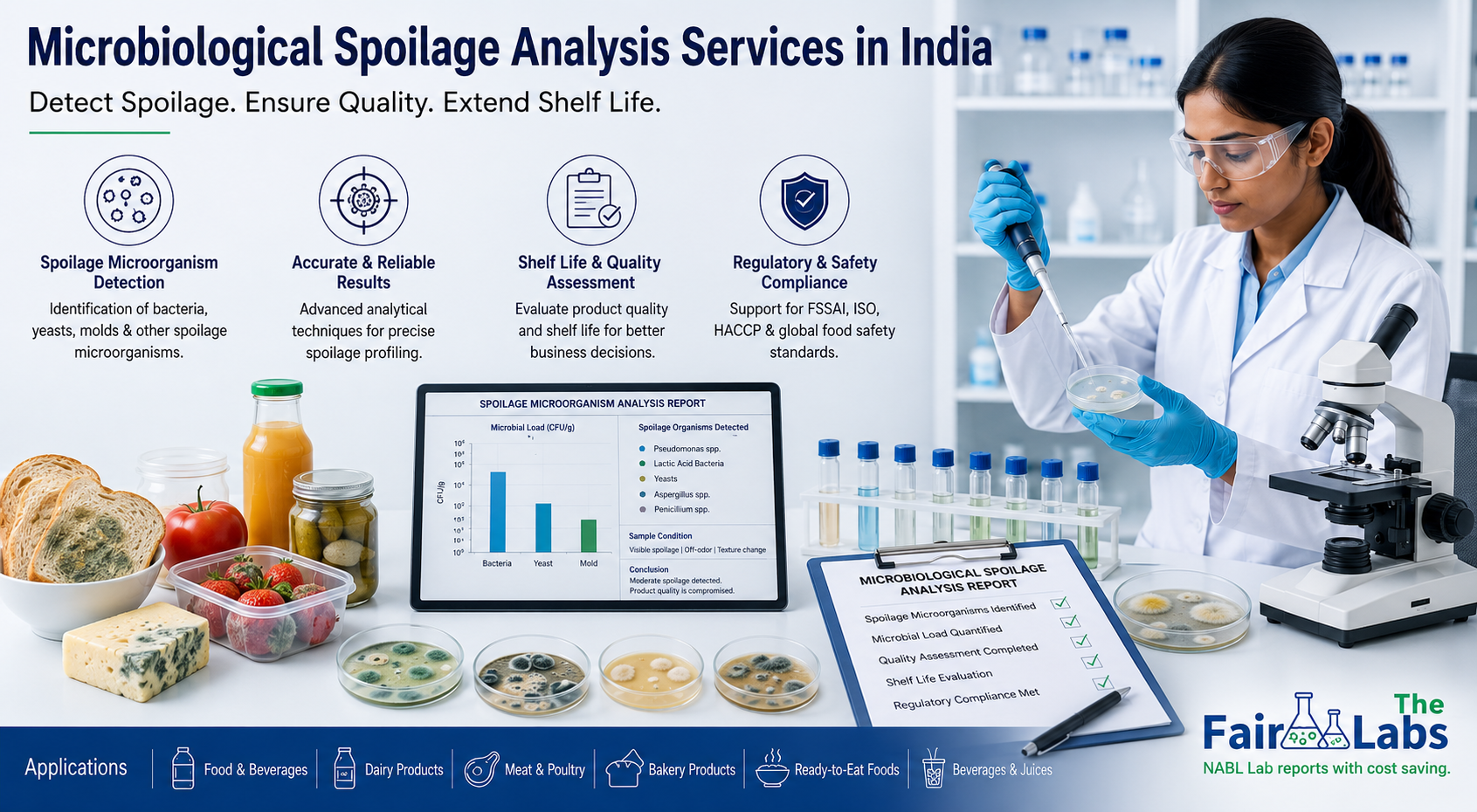
What is Microbiological Spoilage Analysis?
Microbiological Spoilage Analysis is the identification and evaluation of microorganisms — bacteria, yeasts, and moulds — that cause deterioration in the sensory, physical, or chemical quality of a product. This includes changes in taste, odour, appearance, texture, and overall product integrity.
It is important to understand the distinction between spoilage microorganisms and foodborne pathogens:
A product can appear completely normal while still carrying pathogenic risk, and conversely, a product may show clear spoilage signs without posing any direct health hazard. This is why spoilage analysis and pathogen testing serve complementary but distinct purposes within a comprehensive food safety and quality program.
Spoilage can be visible — such as mould growth, gas bloating, or discoloration — or invisible, where microbial activity has begun degrading quality at a microscopic level before any outward signs appear. Early detection through systematic microbiological spoilage analysis allows manufacturers to intervene before spoilage reaches the consumer, and provides critical data to support real-time and accelerated shelf-life studies.
For manufacturers, spoilage analysis is not just a quality check — it is a strategic tool for protecting brand reputation, minimizing waste, validating packaging and formulation decisions, and ensuring products perform as promised throughout their labelled shelf life.
Why Microbiological Spoilage Analysis is Important
Microbiological spoilage analysis supports multiple pillars of a manufacturer's quality and compliance strategy:
Quality & Compliance Benefits
- Product Quality — ensures taste, appearance, and texture remain consistent throughout shelf life
- Shelf-Life Validation — provides microbiological evidence to support real-time and accelerated stability studies
- Consumer Satisfaction — reduces the likelihood of spoiled products reaching consumers
- Food Safety Programs — strengthens HACCP-based hazard identification and control
- HACCP — supports critical control point verification related to microbial risk
- GMP — reinforces good manufacturing practice through documented quality monitoring
- ISO 22000 — contributes data to food safety management system requirements
- FSSC 22000 — supports certification audits requiring documented microbiological control
- Export Compliance — meets international buyer and regulatory documentation requirements
- Quality Assurance — provides ongoing verification of production and storage hygiene
- Product Development — informs formulation, preservative, and packaging decisions
- Root Cause Investigation — identifies the specific organisms responsible for a quality failure or complaint
Risks of Ignoring Microbiological Spoilage
Manufacturers that do not conduct regular spoilage analysis face avoidable risks, including:
- Premature product spoilage before the end of labelled shelf life
- Increased customer complaints and negative reviews
- Costly product recalls and destruction of stock
- Direct economic losses from wasted production
- Reduced effective shelf life compared to label claims
- Packaging failures that allow microbial ingress
- Storage and cold-chain related quality issues
- Losses during distribution and retail handling
- Long-term damage to brand reputation and retailer relationships
Common Spoilage Microorganisms We Analyze
The Fair Labs identifies and characterizes a wide range of spoilage-causing bacteria, yeasts, and moulds relevant to your specific product category.
Bacteria
- Lactic Acid Bacteria — cause souring, gas formation, and slime in dairy, beverages, and processed foods
- Pseudomonas spp. — associated with off-odours, discoloration, and sliminess in dairy, meat, and refrigerated products
- Bacillus spp. — cause spoilage in bakery and processed foods, including ropy bread spoilage
- Clostridium spp. — associated with gas production and spoilage in canned and vacuum-packed foods
- Enterobacteriaceae — indicator organisms linked to hygiene failures and early spoilage in multiple food categories
- Thermophilic Spoilage Bacteria — cause spoilage in heat-processed and canned products under specific storage conditions
Yeasts
- Saccharomyces spp. — cause fermentation-related spoilage in beverages, juices, and syrups
- Candida spp. — associated with spoilage in dairy and fermented products
- Zygosaccharomyces spp. — known for spoiling high-sugar and acidic products such as jams, sauces, and concentrates
- Osmophilic Yeasts — thrive in high-sugar environments, spoiling syrups, honey-based products, and concentrates
Yeasts are particularly significant in beverages, juices, syrups, jams, sauces, dairy products, and fermented foods, where they cause fermentation off-flavours, gas production, and container bloating.
Moulds
- Aspergillus — common in cereals, spices, and nuts; associated with visible growth and mycotoxin risk
- Penicillium — frequently spoils bakery products, dairy, and fruits with visible colonization
- Rhizopus — causes soft rot in fruits and spoilage in bakery products
- Mucor — associated with spoilage in fruits, vegetables, and processed foods
- Fusarium — impacts cereals and grains, with implications for both spoilage and mycotoxin risk
Moulds have a significant impact on cereals, bakery products, spices, dairy products, nuts, fruits, and processed foods, often producing visible growth along with musty odours and textural degradation.
Products We Test
Food Products
Dairy Products, Bakery Products, Snacks, Ready-to-Eat Foods, Processed Foods, Frozen Foods, Spices, Condiments
Beverages
Fruit Juices, Soft Drinks, Energy Drinks, Dairy Beverages, Functional Drinks
Nutraceutical Products
Protein Powders, Gummies, Capsules, Tablets, Liquid Supplements
Herbal Products
Powders, Syrups, Capsules, Oils, Herbal Formulations
Spoilage Parameters We Evaluate
| Parameter | Purpose | Test Method | Importance |
|---|---|---|---|
| Total Plate Count | Assess overall microbial load | Standard plate culture method | General indicator of hygiene and spoilage risk |
| Yeast & Mould Count | Detect fungal spoilage organisms | Selective culture media | Predicts fermentation and mould-related spoilage |
| Lactic Acid Bacteria | Detect souring/fermentation organisms | Selective culture media | Key spoilage indicator in dairy and beverages |
| Spoilage Organism Identification | Identify specific causal organisms | Biochemical/microscopic identification | Enables targeted root cause resolution |
| Bacterial Enumeration | Quantify bacterial spoilage load | Culture-based counting | Tracks spoilage trend over time |
| Fungal Identification | Confirm mould/yeast species | Microscopy and culture morphology | Supports formulation and preservation decisions |
| pH Changes | Detect fermentation/chemical shifts | pH meter | Early indicator of microbial activity |
| Water Activity | Predict microbial growth potential | Water activity meter | Key predictor of spoilage susceptibility |
| Sensory Evaluation | Detect quality changes | Trained sensory panel | Confirms real-world impact of spoilage |
| Shelf-Life Correlation | Link microbial data to shelf-life claims | Comparative trend analysis | Validates and refines expiry date decisions |
Tracking these parameters over time allows manufacturers to identify spoilage trends before visible deterioration occurs, enabling corrective action while there is still time to protect product quality and prevent losses.
Laboratory Methods & Technologies
The Fair Labs employs a combination of traditional and advanced microbiological techniques to ensure accurate, reproducible spoilage analysis:
Together, these technologies improve the accuracy, reliability, and turnaround time of microbiological spoilage analysis, giving manufacturers dependable data for quality and shelf-life decisions.
Standards & Guidelines We Follow
The Fair Labs conducts microbiological spoilage testing in alignment with recognized national and international standards, including:
Accredited microbiological testing under these frameworks strengthens regulatory confidence, supports certification audits, and reinforces the overall reliability of your product's quality and shelf-life claims.
Industries We Serve
Our Microbiological Spoilage Analysis Process
Why Choose The Fair Labs?
Related Testing Services
- Shelf Life Testing
- Real Time Shelf Life Studies
- Stability Chamber Studies
- Food Microbiological Testing
- Water Testing
- Food Safety Testing
- Pathogen Testing
- Environmental Monitoring
- Packaging Testing